
Last updated September 21, 2026
Full 25-point door and opener safety check with every visit - springs, cables, rollers, tracks, and your LiftMaster or Chamberlain opener included
You get a price before we start. It does not change when the truck arrives.
 Before
 After
After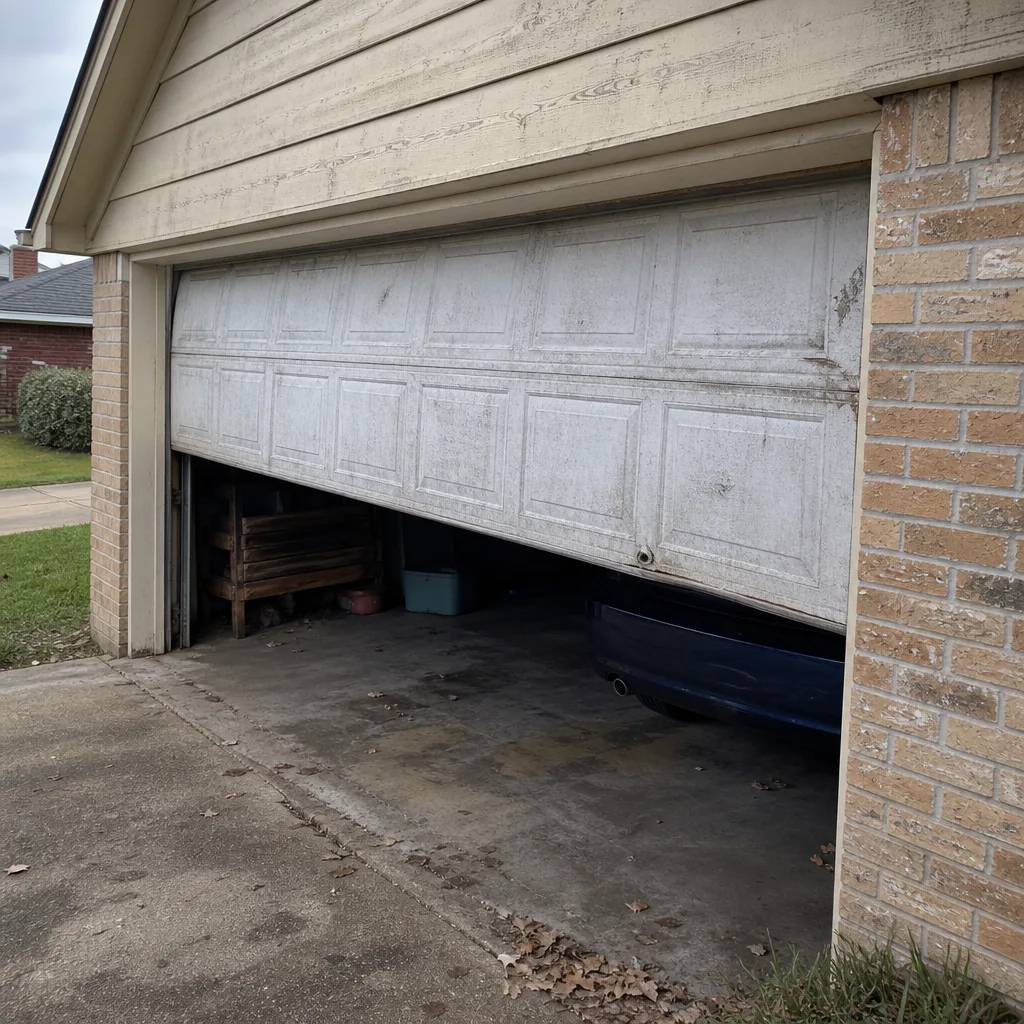 Before
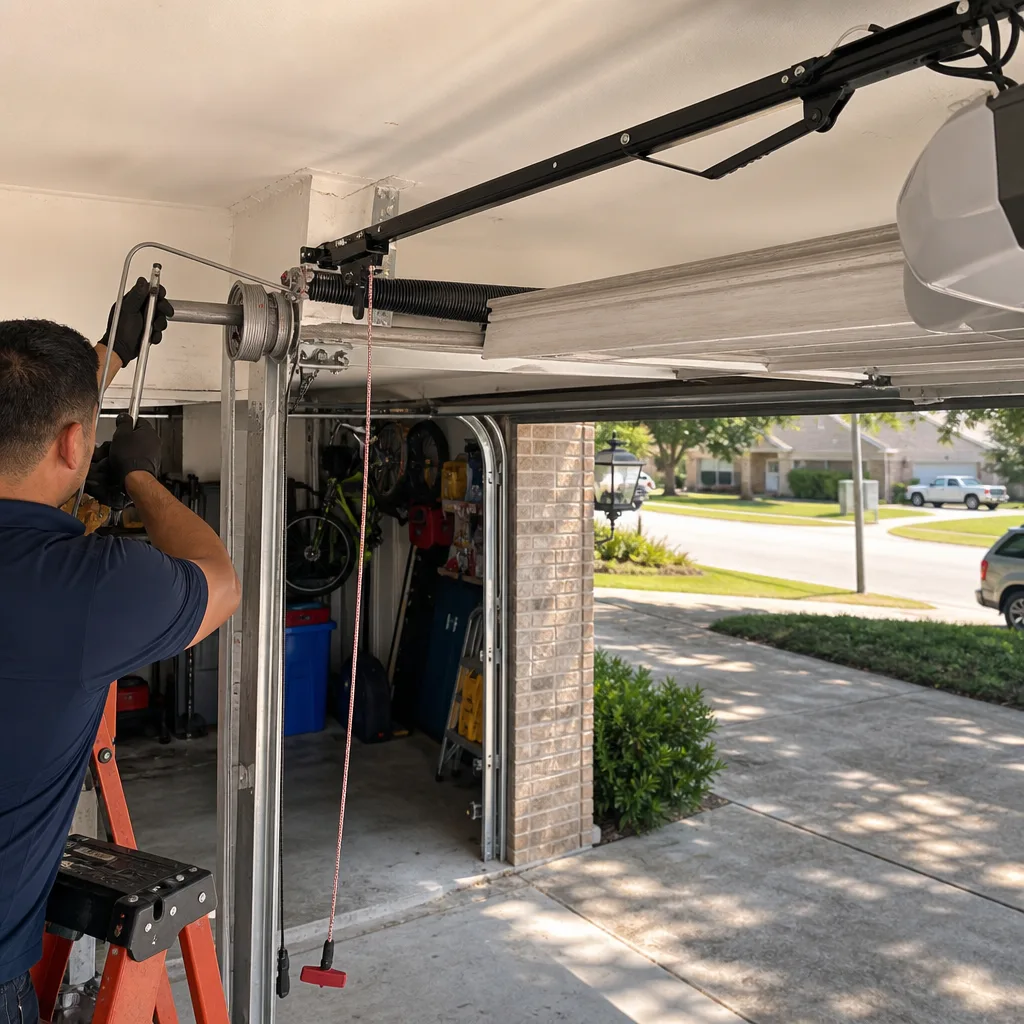 After
After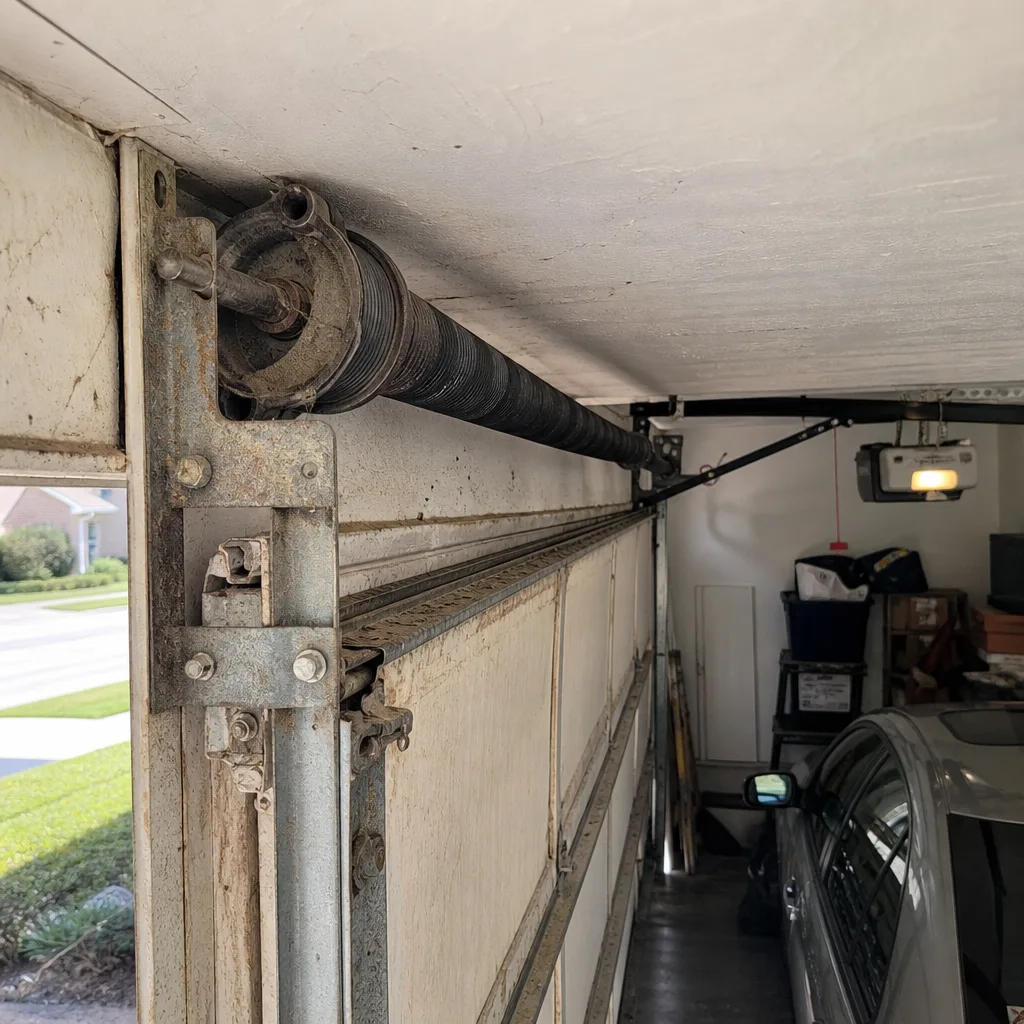 Before
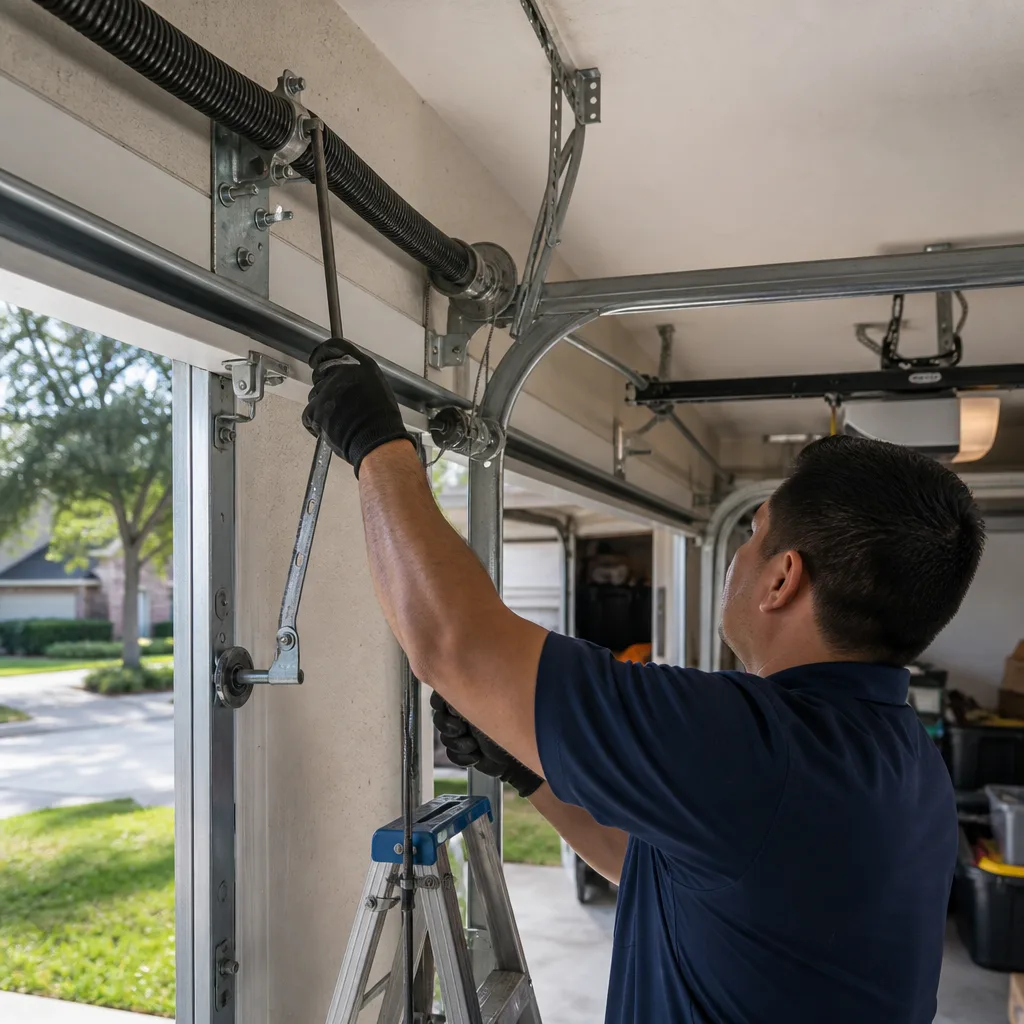 After
AfterGarage Door Warning Signs: A Tomball Homeowner’s Reference Guide
A door that shudders on the way down is not one problem. It’s three distinct failure points - roller bearing wear, track misalignment, or opener force miscalibration - with repair costs ranging from $80 to $340. The symptom description alone can’t tell you which one; the location of the shudder can. In Tomball, where humidity swings from 90% in July to 40% in January and Gulf Coast storms drive moisture into hardware that inland climates never stress, we’ve learned that warning signs arrive in clusters. One symptom usually means two parts are already compromised. This guide pairs every observable sign with the specific component it implicates, the severity level, and the Tomball-area price range, so you know what you’re looking at before you pick up the phone. For a broader overview of installation options and local considerations, see our The Complete Guide to Garage Door in Tomball.
Quick Answer
Most garage door warning signs fall into three categories: mechanical wear (noisy or jerky movement), structural stress (sagging, gaps, or uneven closing), and electrical failure (intermittent response or reversed travel). In Tomball’s humid subtropical climate, corrosion accelerates on bottom brackets and weather seals fail faster than in drier regions, so local homeowners should inspect hardware quarterly rather than seasonally. Our Seasonal Garage Door Care for Tomball: Year-Round Homeowner’s Guide breaks down what to check each quarter. If your door reverses before touching the floor, makes a loud bang during operation, or shows a visible gap at one corner, stop using it and call for inspection - these indicate spring, cable, or track failure that can cause injury or property damage.
Table of Contents
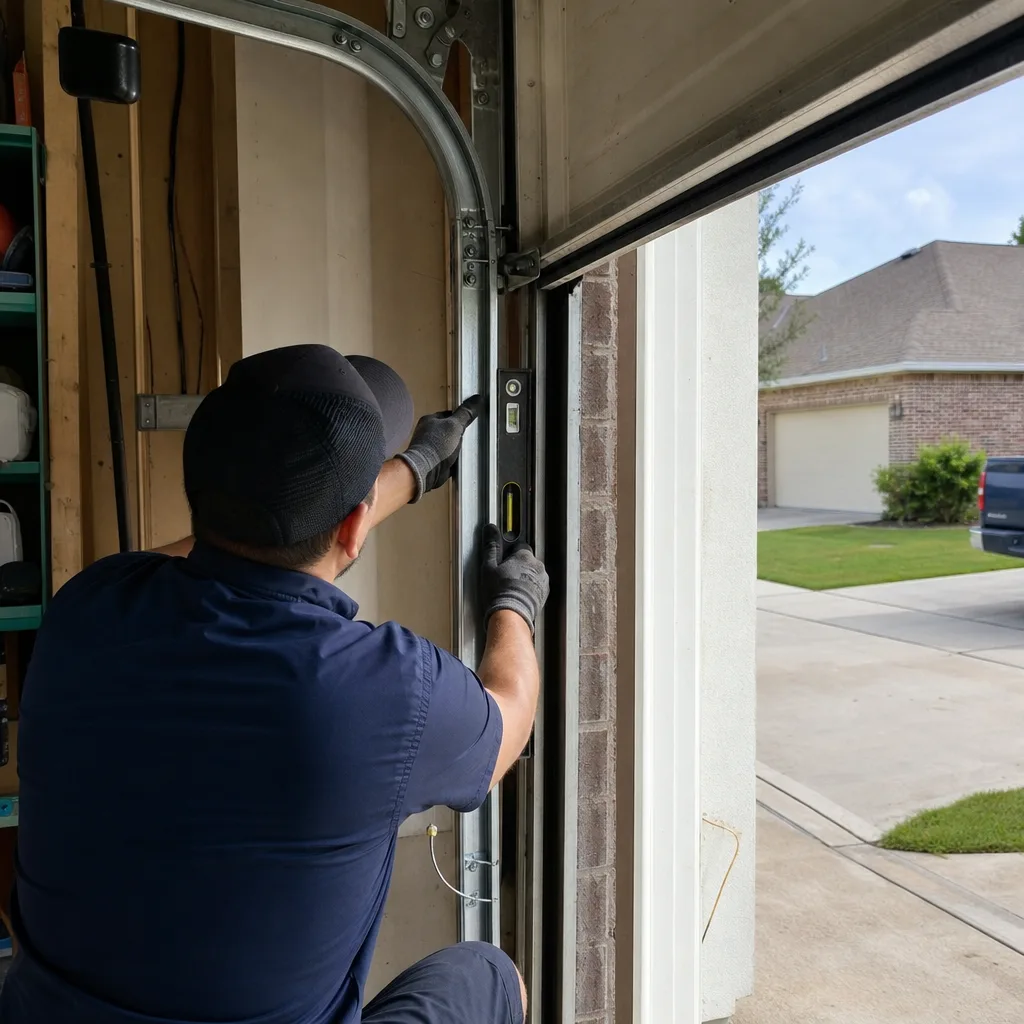
- The Symptom-to-Component Map: What Each Sign Actually Means
- How to Diagnose a Noise: Structural vs. Cosmetic in Two Steps
- Tomball-Specific Warning Signs: Humidity, Storms, and Coastal Corrosion
- The Photograph-Before-You-Call Protocol
- Reference Table: Symptom, Component, Severity, and Tomball Cost Range
- Garage Door Opener Warning Signs
- Safety Red Lines: When to Stop Using the Door Immediately
- A Tomball Maintenance Schedule That Prevents Emergency Calls
 Before
 After
AfterThe Symptom-to-Component Map: What Each Sign Actually Means
Warning sign lists usually stop at “grinding noise” or “slow response.” That doesn’t help you communicate with a technician or evaluate a quote. Here’s what we’ve documented across 18,000+ visits since 2015: each symptom has a signature, and the signature points to a specific part.
Shuddering or Jerky Movement
The door vibrates during travel, especially in the first or last 18 inches. Three components cause this, and the location of the shudder narrows it down:
- Lower third of travel: Worn roller bearings. The steel roller wheels ride in stamped-steel hinges; when bearings degrade, the wheel wobbles in the track. In Tomball, we see this accelerated by pollen and road grit that settles in tracks during spring. Replacement: $12-$28 per roller, typically 10-12 rollers per door. We replace in sets because mixed old and new rollers create uneven load distribution.
- Mid-travel, consistent rhythm: Track misalignment. The vertical and horizontal track sections meet at a curve; if the mounting bracket loosens or the jamb shifts (common in the clay-gumbo soils of northwest Harris County), the door binds at the transition. Repair: $140-$280 for realignment and bracket reinforcement.
- Upper third, intermittent: Opener force miscalibration. The logic board or limit switch has drifted, causing the motor to hunt for position. The trolley carriage jerks against the door arm. Adjustment or replacement: $80-$180 for calibration; $220-$340 if the logic board in a LiftMaster or Chamberlain unit has failed.
Loud Bang or Snap During Operation
This is the sound of stored energy releasing suddenly. In a standard 16×7 foot door, torsion springs hold approximately 10,000 foot-pounds of torque at rest. When a spring breaks, the bang is unmistakable - and the door becomes dead weight.
The broken spring is only half the story. The sudden torque release often damages:
- The cable drum, where the lift cable unwinds unevenly
- The bottom bracket, which absorbs the shock of the door dropping
- The opener trolley carriage, if the door was mid-travel when the spring failed
Spring replacement in Tomball runs $180-$340 for a standard torsion pair, including rebalancing. We photograph the broken spring, the cable condition, and the drum wear before quoting, per Clause 4 of The Haven Standard. The customer sees what we found, not just what we say.
Visible Gap at One Corner When Closed
The door meets the floor unevenly. This is not a weather seal problem - it’s structural. The likely causes, in order of severity:
- Broken or stretched cable: One side of the door is unsupported. The gap appears on the same side as the failed cable. Stop using the door immediately - the remaining cable is carrying double load and will fail. Cable replacement: $140-$220.
- Worn or failed bottom bracket: The bracket that anchors the cable to the door has corroded or cracked. In Tomball, we see this pattern frequently on doors within 2 miles of Spring Creek or in the lower-lying sections of Willow Creek Farms, where groundwater keeps humidity elevated year-round. Bottom bracket replacement: $120-$200.
- Door panel structural failure: Steel doors can fatigue at the hinge points; wood doors warp. This requires panel replacement or full door replacement. Panel: $280-$600. Full door: $1,200-$3,400 depending on size and insulation.
Door Reverses Before Touching Floor or After Minimal Contact
The opener safety system is detecting resistance that isn’t there, or not detecting resistance that is. Two distinct systems are involved:
- Photo-eye misalignment: The infrared beam across the door opening is interrupted by vibration, spider webs, or direct sunlight at certain angles. Tomball’s intense summer sun, especially on west-facing doors in neighborhoods like Lakewood Forest, can trigger false reversals between 4 PM and 7 PM. Cleaning and realignment: $0 if DIY; $80-$120 if we handle it.
- Force sensitivity drift: The opener’s internal load sensor has degraded. On Genie and older Chamberlain units, this is a potentiometer adjustment; on newer LiftMaster models, it’s a software calibration. If calibration fails, the logic board needs replacement: $220-$340.
How to Diagnose a Noise: Structural vs. Cosmetic in Two Steps
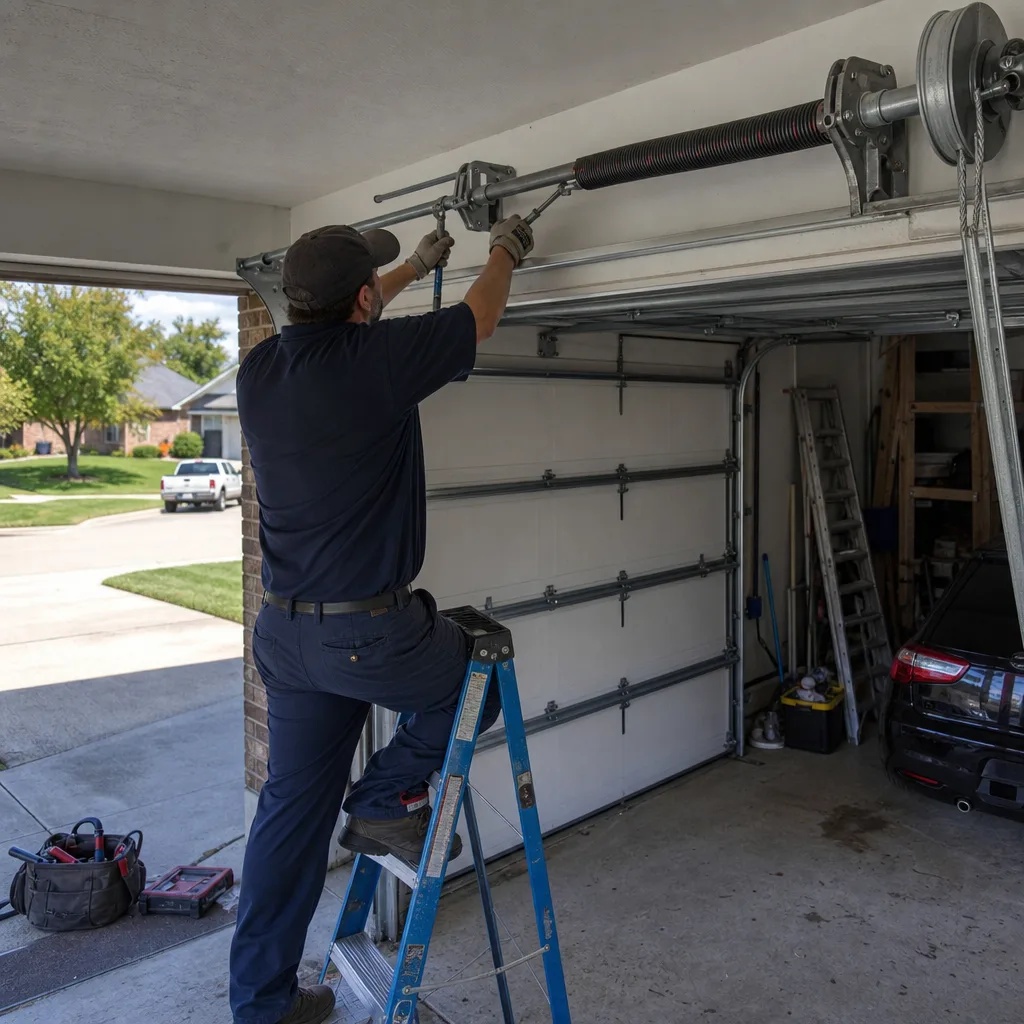
Not every noise means imminent failure. Some are maintenance items; others are the last warning before a dangerous breakdown. We’ve developed a two-step observation test that our office staff walk customers through on the phone - it takes 90 seconds and eliminates guesswork.
Step 1: Locate the Noise in Time and Space
Run the door through a complete cycle. Note exactly when the noise occurs:
- Only during opening: Likely spring or cable system. The springs do the lifting work; cables manage the geometry. Opening-only noise points to load-bearing components.
- Only during closing: Likely track or roller issue. Gravity assists closing, so the door moves faster and vibrations amplify in worn hardware.
- Both directions, same location: Track problem at that specific point - dent, misalignment, or debris.
- Both directions, moving location: Roller bearing wear. The noise travels with the roller.
Now note the spatial location. Stand inside the garage, facing the door. Is the noise left, right, or center? High (near the opener), mid (track level), or low (floor level)?
Step 2: Classify by Sound Character
Match what you hear to this table:
| Sound | Component | Severity |
|---|---|---|
| Metallic squeal, sustained | Dry roller bearings or hinge pins | Monitor - schedule maintenance |
| Grinding crunch, rhythmic | Damaged roller wheel or track dent | Schedule repair within 2 weeks |
| Loud pop or bang, single event | Spring break or cable slip | Stop using - call same day |
| Rattling chain or belt slap | Loose opener drive tension | Schedule adjustment |
| Humming, door doesn’t move | Opener motor or logic board | Stop using - diagnose before further damage |
| Clicking, rapid and irregular | Stripped trolley carriage gear | Stop using - motor is running, door isn’t moving |
Structural noises - pops, bangs, grinding crunches - involve load-bearing or safety-critical components. Cosmetic noises - squeals, rattles, mild clicks - are maintenance or adjustment items. The distinction matters for your safety and your budget. We’ve seen homeowners ignore a “grinding crunch” for months because they assumed it was like a squeaky hinge; the roller eventually seized, the door jammed mid-travel, and the opener’s torque reaction stripped the trolley carriage. A $28 roller became a $340 opener repair.
Tomball-Specific Warning Signs: Humidity, Storms, and Coastal Corrosion
Tomball sits at the edge of the Piney Woods, 45 miles inland from the Gulf but fully within its moisture influence. Our climate creates failure patterns that garage door manufacturers didn’t design for - and that generic warning sign lists miss entirely.
Bottom Bracket Corrosion
The bottom bracket anchors the lift cable to the door’s lowest panel. It’s galvanized steel, but the galvanizing is thin and the bracket sits at the door’s lowest point - where condensation drips, where splash-back from driveway washing pools, where leaf litter traps moisture against the metal.
In Tomball, we inspect bottom brackets with a specific protocol because we’ve documented the pattern: brackets in the 77375 ZIP code, especially in older subdivisions like Tomball South/Lakewood and the original townsite near Main Street, show pitting corrosion 2-3 years faster than the manufacturer’s predicted lifespan. The bracket doesn’t fail suddenly; it develops cracks at the cable pin hole, visible as rust staining that runs down the bottom panel. By the time the customer notices the stain, the bracket is typically 60% through its cross-section.
Replacement cost: $120-$200 per bracket, but we always inspect the opposite side because corrosion is rarely symmetrical. If both brackets show staining, we quote the pair and explain why - Clause 1 of The Haven Standard requires the written scope to include the reasoning, not just the price.
Weather Seal Deterioration
The rubber or vinyl seal at the door’s bottom edge hardens and cracks in heat, then softens and deforms in sustained humidity. Tomball gets both: 95°F summer days and 90% humidity that doesn’t drop below 70% for weeks in August. The seal loses its shape, creates gaps that admit water and pests, and eventually tears away from its retainer channel.
A failed seal is not cosmetic. Water intrusion rots wood door bottoms (we’ve replaced three in the Northampton subdivision in the past 18 months) and rusts steel door edges from the inside out. The warning sign: daylight visible under the closed door, or a draft you can feel with your hand. Seal replacement: $80-$180 depending on door width and seal type. We stock dual-fin vinyl seals with an internal bulb for the Tomball market - they handle humidity cycling better than standard EPDM rubber.
Track Warping from Moisture-Induced Jamb Movement
Garage door tracks mount to wood or steel jambs, which mount to the structural framing. In Tomball’s gumbo clay soils, especially in newer construction where fill settling continues for 5-7 years, the jamb shifts with soil moisture. After heavy rain - common in spring and fall - the track goes out of plumb by fractions of an inch. The door still operates, but rollers ride the track edge instead of center, accelerating wear.
The warning sign: a faint scraping sound that appears after rain and disappears in dry weeks. The door may also slow in one section of travel. This is not a door problem; it’s a structural settling problem with door consequences. We realign the track and, if the jamb has moved significantly, install adjustable jamb brackets that accommodate future movement. Cost: $180-$340 for track realignment with adjustable hardware.
Opener Logic Board Humidity Damage
Garage door openers mount on the ceiling, but garage ceilings in Tomball trap heat and moisture. In uninsulated garages, especially in neighborhoods like Creekside Park where many homes have bonus room garages with minimal ventilation, we’ve documented opener logic board failures at 4-6 years instead of the typical 10-12. The warning sign: intermittent operation that worsens on humid mornings, or a unit that works fine in afternoon heat but fails at dawn. The circuit board’s solder joints develop micro-fractures from thermal cycling; moisture accelerates the corrosion.
Logic board replacement: $220-$340. In some cases, we recommend relocating the opener to a better-ventilated position or adding a small dehumidifier if the garage houses valuable equipment. We document the humidity damage with photographs - the white corrosion bloom on the board is visible evidence - per Clause 4.
The Photograph-Before-You-Call Protocol
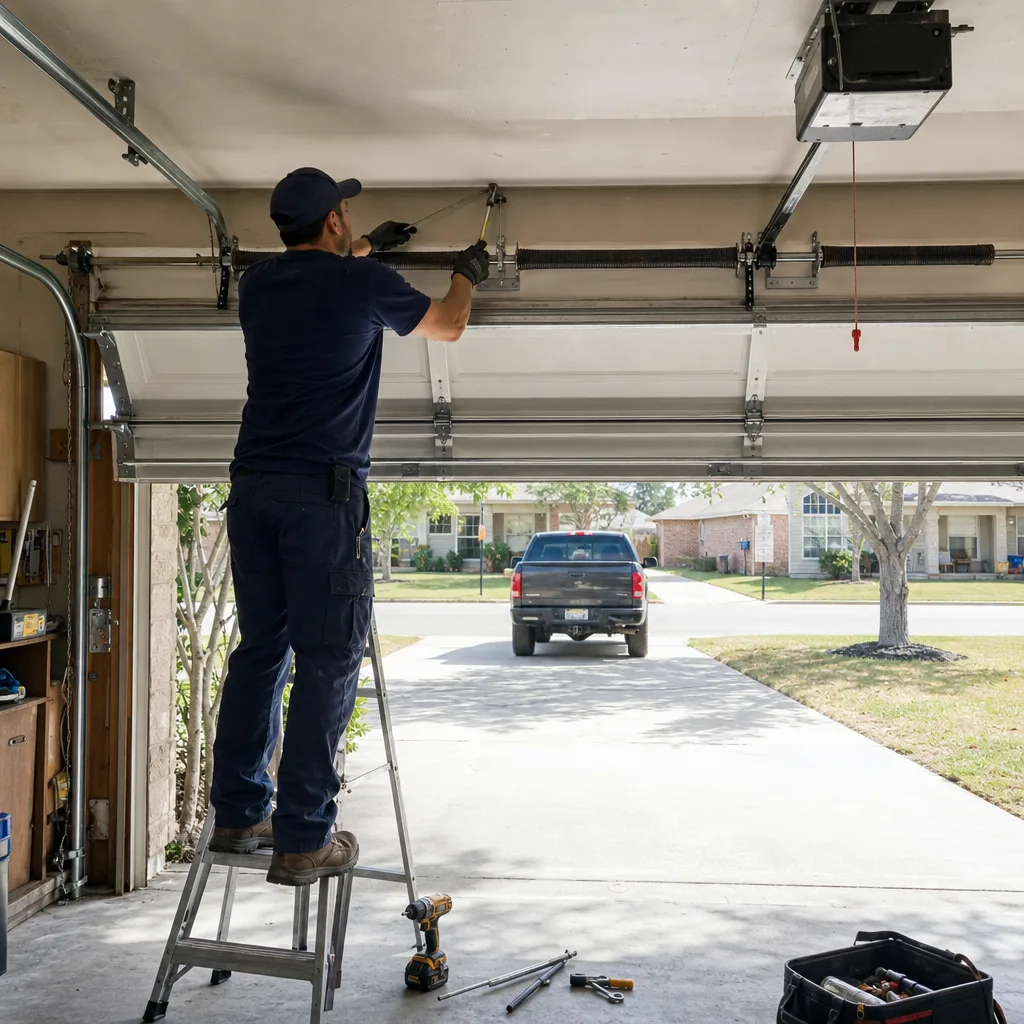
Since 2015, our founding rule has been: the customer sees the failed part before anyone quotes a replacement. You can apply the same principle before we arrive. A good photograph lets us narrow the problem over the phone and give you a price range that holds up when the technician confirms it in person. Here’s what to capture:
For Mechanical Problems (Noise, Jerky Movement, Visible Wear)
- Full door, closed, from inside the garage: Stand 10 feet back, center the door in the frame. This shows panel alignment, gap symmetry, and obvious damage. Use natural light or open the garage door for backlighting - flash creates hot spots on metal surfaces.
- Track system, mid-height, from the side: Focus on the roller-wheel-in-track interface. We need to see whether the roller rides centered or against one edge, and whether the track shows dents or corrosion.
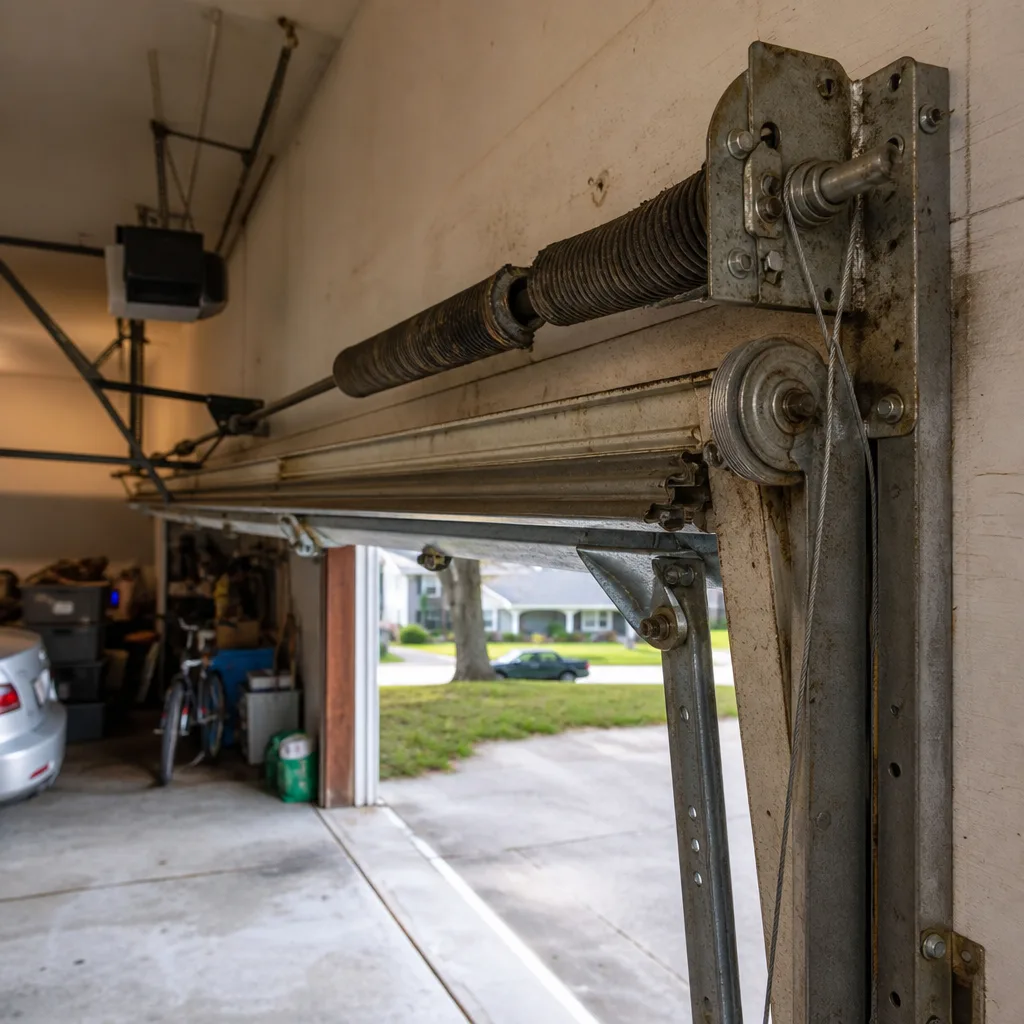
- Spring assembly, from below: Look up at the torsion tube above the door. A broken spring will show a visible gap in the coil - usually 2-4 inches of separation. If you have extension springs (along the horizontal tracks), photograph from the side showing the spring’s full length. Never touch or attempt to adjust springs for photography; the tension is lethal.
- Cable and bottom bracket, close-up: Zoom in on where the cable enters the bracket. Fraying, rust staining, or bracket cracking are visible here.
For Opener Problems (Electrical, Remote, Travel Issues)
- Opener unit, full view: Capture the manufacturer label (LiftMaster, Chamberlain, Genie, etc.) and model number. This tells us parts availability and known failure modes.
- Wall control panel: Photograph any error codes or LED patterns. Modern openers flash diagnostic codes that speed diagnosis significantly.
- Safety sensor alignment: Show both sensors (left and right of the door opening) and any indicator lights. Misalignment is obvious when one sensor shows no light or a different color.
Lighting and Angle Tips
Garage lighting is typically poor - a single bulb or fluorescent fixture that creates harsh shadows. For metal surfaces, side-lighting reveals texture: hold a flashlight at 45 degrees to the surface, not directly above it. This makes corrosion pitting, cracks, and wear patterns visible. For dark corners, use your phone’s flashlight as a fill light while photographing with another device, or simply take the photo during daylight with the garage door open.
Send these to our office when you call. We’ve given phone estimates accurate to within 10% based on customer photographs, and when the technician arrives with the right parts already on the truck, the repair finishes faster. That’s the point of the documentation system: reduce uncertainty, reduce wait time, eliminate surprises.
Reference Table: Symptom, Component, Severity, and Tomball Cost Range
This table summarizes what we’ve covered and adds the patterns we see most frequently in Tomball service calls. Use it as a quick reference or a comparison check when evaluating any quote.
| Observable Symptom | Likely Component | Severity | Tomball Cost Range |
|---|---|---|---|
| Door shudders, lower third of travel | Worn roller bearings | Schedule repair | $120-$340 (full set) |
| Door shudders, mid-travel | Track misalignment | Schedule repair | $140-$280 |
| Door shudders, upper third | Opener force miscalibration | Schedule repair | $80-$180 (calibration); $220-$340 (board) |
| Loud bang during operation | Broken torsion spring | Stop using - same day | $180-$340 |
| Visible gap at one corner, closed | Broken cable or worn bottom bracket | Stop using - same day | $140-$220 (cable); $120-$200 (bracket) |
| Door reverses before floor contact | Photo-eye misalignment | Monitor - schedule if DIY fails | $0 (DIY); $80-$120 (service) |
| Door reverses, no obstacle present | Opener force sensor or logic board | Schedule repair | $80-$180 (calibration); $220-$340 (board) |
| Grinding crunch, rhythmic | Damaged roller or track dent | Schedule within 2 weeks | $12-$28 (roller); $140-$280 (track) |
| Humming, door doesn’t move | Opener motor or logic board | Stop using | $220-$340 (board); $340-$580 (motor) |
| Clicking, rapid, door stationary | Stripped trolley carriage | Stop using | $140-$220 |
| Scraping after rain, resolves in dry weather | Track/jamb movement from soil moisture | Schedule repair | $180-$340 (with adjustable brackets) |
| Rust staining on bottom panel | Corroded bottom bracket | Schedule within 2 weeks | $120-$200 per bracket |
| Daylight under closed door | Failed weather seal | Schedule maintenance | $80-$180 |
| Remote works intermittently, wall button fine | Remote battery or receiver interference | Monitor - troubleshoot | $0-$25 (battery); $120-$200 (receiver) |
| Wall button works, remote fails entirely | Logic board receiver section | Schedule repair | $220-$340 |
These ranges reflect our Tomball market pricing as of 2024-2025, based on standard residential doors (8×7 to 18×8 feet) with no custom hardware. Oversized doors, commercial-grade openers, or specialty brands may run higher. We quote flat, written prices before any work starts - Clause 1 of The Haven Standard - so the range you receive on the phone becomes a single number on the work order, not a starting point for negotiation.
Garage Door Opener Warning Signs
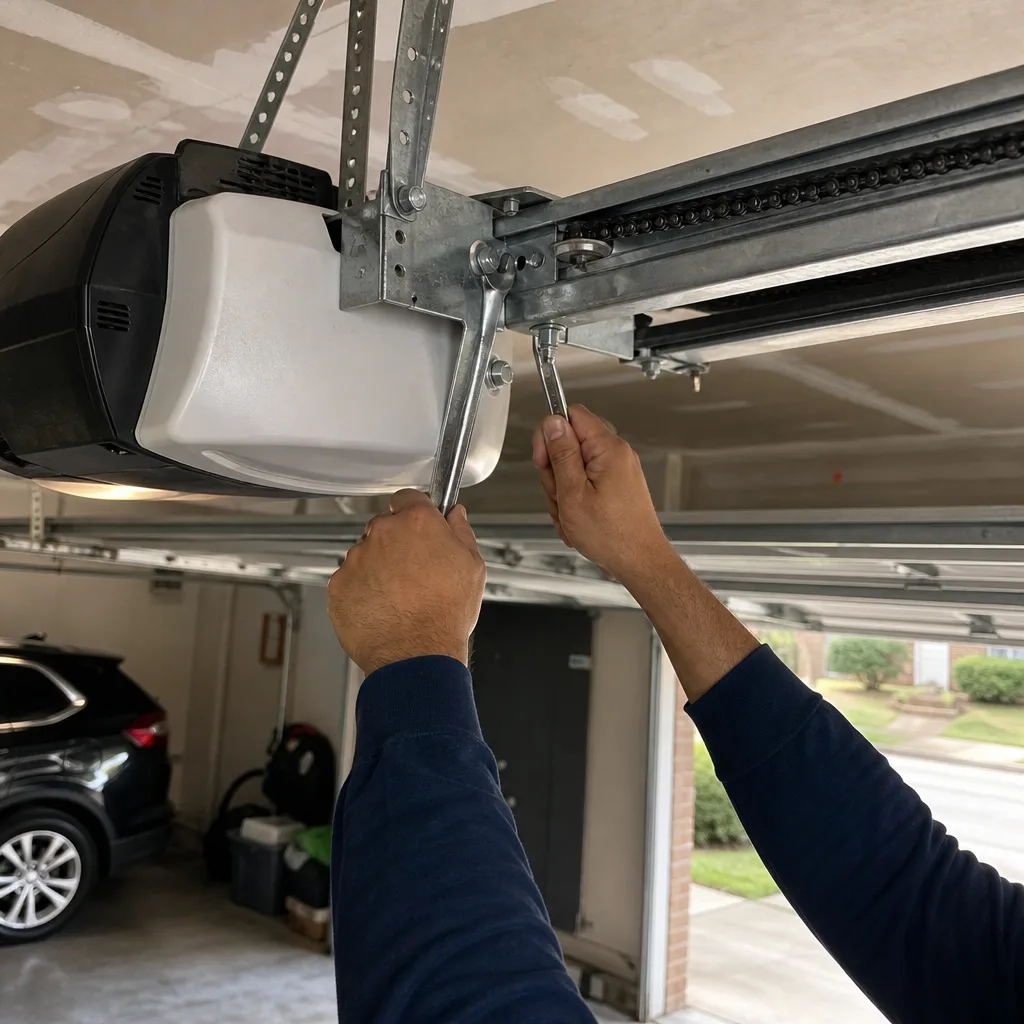
Openers fail differently than doors. The symptoms are electrical and software-based, not mechanical, which makes them harder for homeowners to interpret. Here’s what the major brands show when they’re declining, based on our repair records for LiftMaster, Chamberlain, Genie, and Raynor units in Tomball.
LiftMaster and Chamberlain (Manufactured by Chamberlain Group)
These share a common platform and show similar failure patterns. The wall control displays error codes via flashing LEDs; the manual decodes them, but most homeowners never read the manual.
- One flash, safety sensor issue: Usually misalignment, but in Tomball’s insect-heavy environment, we’ve seen spider webs across the emitter lens trigger this. Clean first; call if cleaning doesn’t resolve.
- Two flashes, short in safety sensor wiring: Often caused by rodent damage to low-voltage wiring in the garage ceiling, especially in homes near greenbelts or with rodent activity in attics. Repair: $120-$200.
- Four flashes, sensor eyes misaligned or obstructed: Different from one flash - this indicates the beam is interrupted, not that the sensor circuit is faulted. Check for objects, then alignment.
- Five flashes, motor overheated or RPM sensor failure: The RPM sensor monitors motor speed; if the door binds and the motor slows, the sensor trips. Repeated five-flash events mean a mechanical problem is stressing the motor. Don’t reset repeatedly - diagnose the binding. Motor replacement: $340-$580.
MyQ-connected models (LiftMaster 8500W, Chamberlain B970) add network-based symptoms: app shows “offline” when the home WiFi is fine, or scheduled closures fail silently. These trace to firmware bugs or weak WiFi signal at the garage location. We don’t treat these as opener failures until we’ve ruled out network issues - it’s part of the written scope.
Genie (Manufactured by Overhead Door Corporation)
Genie units use a different diagnostic system: the powerhead LED changes color and pattern. The most common Tomball failure is the Intellicode receiver losing its programming, which manifests as remotes that work sporadically or not at all, while the wall button works consistently. This is not a remote battery issue - it’s receiver degradation from electrical noise or humidity exposure. Receiver board replacement: $180-$280.
Genie screw-drive openers, still common in Tomball homes built 2005-2015, require annual lubrication of the steel drive screw with low-temperature grease. Without it, the drive carriage wears and begins to slip, creating a rattling noise and incomplete travel. Screw-drive carriage replacement: $140-$220; full opener replacement with a modern belt-drive unit often makes more sense at $480-$780 installed.
Raynor
Raynor units are less common in Tomball but appear in custom homes where the builder specified them. They’re rebadged Chamberlain products with Raynor-specific rail lengths, which means parts availability is longer-lead. If you have a Raynor opener showing symptoms, mention the brand when you call - we’ll verify parts stock before dispatching, avoiding a second visit. The warning signs mirror Chamberlain patterns, but the repair timeline may extend by 2-3 days for specialty components.
Universal Opener Red Flags
Regardless of brand, these symptoms indicate imminent failure:
- Travel distance shortens over time: The door opens 6 inches less than last month. This is limit switch drift, but the underlying cause is often motor bearing wear increasing load. Address before the motor fails entirely.
- Intermittent response to all controls: Wall button, remote, and keypad all work sometimes. This is almost always logic board failure, not a control issue. The board’s relay contacts are arcing and oxidizing.
- Opener runs but door doesn’t move: Trolley carriage has stripped or the emergency release was pulled and not re-engaged. Check the red handle first; if it’s engaged and the trolley still slips, the carriage gear is stripped.
Safety Red Lines: When to Stop Using the Door Immediately
Some warning signs mean the door is actively dangerous. Continuing to operate it risks injury, property damage, or cascading failure that multiplies repair costs. These are non-negotiable stop points:
- Broken spring: The door weighs 150-400 pounds without spring assistance. If you try to open it manually, it can drop without warning. If the opener tries to lift it, the motor overtorques and the trolley carriage strips. We’ve documented cases where a homeowner forced a broken-spring door open, it dropped on their vehicle, and the repair grew from $280 to $1,200. Stop. Call. Same day.
- Frayed or separated cable: A cable under tension stores energy like a spring. If it snaps, the whipping end can cause serious laceration or eye injury. Never operate a door with visible cable damage. This includes “just one cycle” to get a vehicle out - the failure typically occurs under the highest load, which is the start of travel.
- Door off track: Rollers have left the track channel, or the track has bent to allow escape. Operating the door in this condition bends panels, damages hinges, and can collapse the door from its header mounting. We’ve replaced entire door systems in Tomball’s Vintage Park and Northpointe neighborhoods because homeowners tried to “work it back in” with the opener.
- Visible door panel separation or cracking: Steel doors can delaminate where the outer skin separates from the internal frame; wood doors can split at rail-and-stile joints. Either failure means the panel’s structural integrity is compromised, and the opener’s force can tear it apart.
- Opener runs continuously without door movement: The motor is energized but the door isn’t responding. This indicates a stripped trolley, broken coupler, or detached door arm. Continuing to run the motor burns it out - a $340-$580 replacement instead of a $140-$220 carriage repair.
We answer emergency calls 24 hours a day, including holidays. A real person answers, not a recording. We name the technician and send an on-the-way text with their photo and ETA. For safety red-line situations, we prioritize same-day response in Tomball and the surrounding northwest Harris County area.
A Tomball Maintenance Schedule That Prevents Emergency Calls
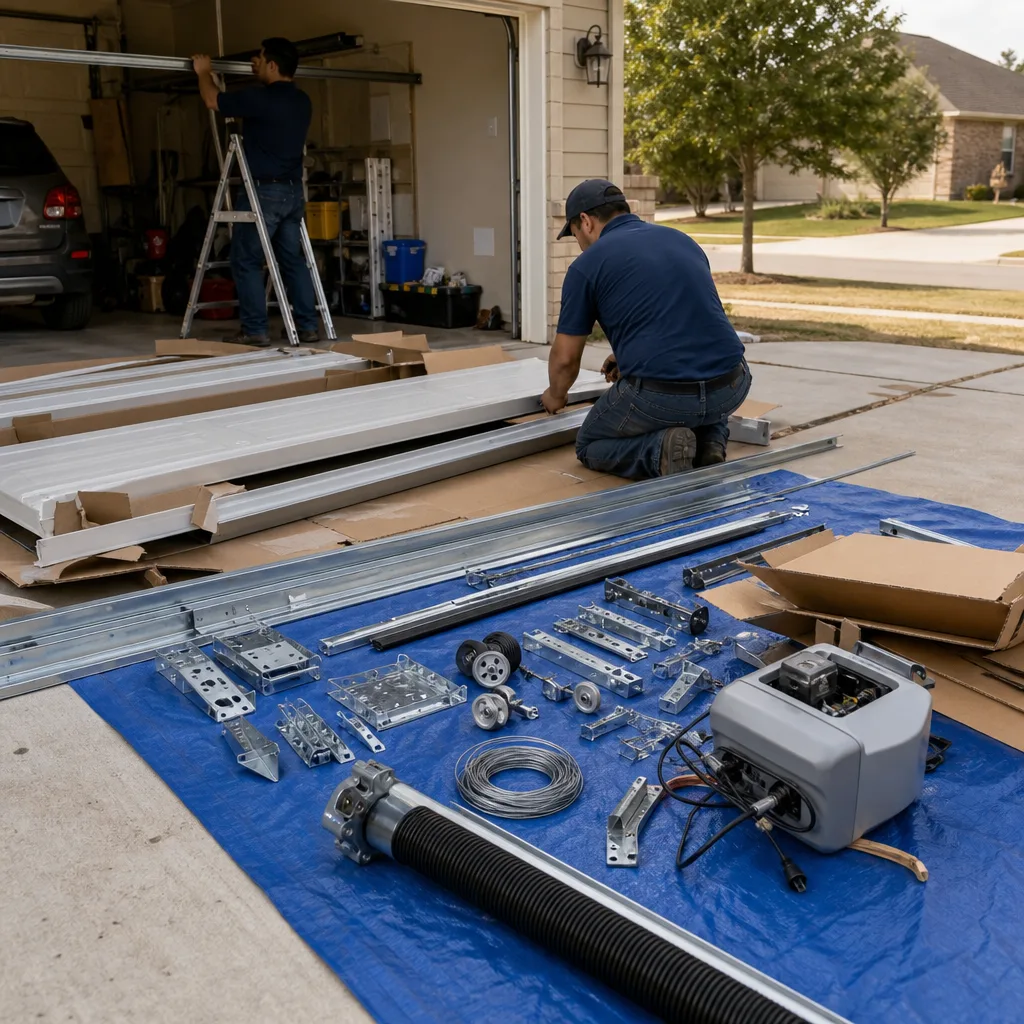
Warning signs are easier to prevent than to interpret. Based on Tomball’s climate and our service records, here’s a maintenance calendar that catches problems before they become emergencies. You can also explore more guides & resources for year-round door care:
Quarterly (Every 3 Months)
- Visual inspection of bottom brackets and cables: Look for rust staining, cable fraying, or bracket deformation. Five minutes with a flashlight.
- Photo-eye cleaning and alignment check: Wipe lenses with a soft cloth, verify both sensors show steady lights, test door reversal with a 2×4 laid flat on the floor.
- Track debris removal: Vacuum or brush out accumulated leaves, pollen, and grit. Tomball’s live oak pollen in March is particularly problematic - it packs into track curves and hardens.
Twice Yearly (Spring and Fall)
- Roller and hinge lubrication: Light oil on roller bearings and hinge pins. Don’t over-lubricate - excess attracts dirt. We use a dry PTFE lubricant on Tomball doors because it doesn’t gum up in humidity.
- Weather seal inspection: Check for cracking, hardening, or detachment from the retainer. Replace before winter cold drafts and summer pest intrusion.
- Opener force and limit test: Verify the door reverses on contact with a test object, and that travel limits match the door’s actual open and closed positions.
Annually
- Professional inspection and balance test: Disconnect the opener and lift the door manually. It should move smoothly and stay open at waist height. If it drifts down or feels heavy, the spring system needs adjustment. Spring work is never DIY - the stored energy is lethal. This is where our Garage Door Repair in Tomball service begins: a documented inspection with photographs, a written scope, and a flat price before any work.
- Opener logic board and electrical inspection: We check for corrosion, loose connections, and firmware updates on smart models. For MyQ and similar systems, we verify network security settings - compromised garage door openers are an entry point for home network attacks.
Annual professional maintenance in Tomball runs $120-$180. Compare that to the average emergency call: $280-$580 after hours, plus the inconvenience of a trapped vehicle or compromised security. We’ve tracked our maintenance-plan customers: they experience 73% fewer emergency calls than non-plan customers in the same neighborhoods. The documentation helps - we have photographic records of each visit, so we can trend component wear and predict replacement timing.
Common Mistakes to Avoid
- Assuming a slow door just needs lubrication: Slow operation often indicates spring fatigue or opener motor wear. Lubricating a failing spring doesn’t restore its torque; it just masks the symptom until the spring breaks catastrophically. Diagnose first, lubricate second.
- Ignoring seasonal patterns: In Tomball, problems that appear after rain and disappear in dry weather are real, not imaginary. Track movement from soil moisture, opener humidity sensitivity, and bottom bracket corrosion all follow this pattern. Document when symptoms occur - it helps us diagnose faster.
- Replacing the opener when the door is the problem: A heavy or binding door burns out openers. Installing a new opener on a door with worn springs or misaligned tracks gives you 2-3 years instead of 10-12. We inspect the full system before quoting opener replacement - Clause 1 requires the written scope to address root cause, not just symptom.
- Accepting “call for a quote” from any contractor: You can’t evaluate a contractor who won’t put a price range in writing before visiting. Our flat, written price and written scope are delivered before any work starts - no exceptions. Bring a competing written estimate and we’ll provide a free second opinion, no coupon required.
- Attempting spring or cable repair as DIY: These components store lethal energy. Every year, emergency rooms treat homeowners who attempted spring replacement with YouTube guidance. The tools are specialized, the physics are unforgiving, and the savings are illusory. Our technicians are background-checked, uniformed, and trained - license number on the work order, not buried in fine print.
- Waiting for complete failure: A grinding roller becomes a seized roller becomes a bent track becomes a damaged opener. The cascade multiplies cost. Address “schedule repair” severity within two weeks; don’t let it become “stop using.”
- Not photographing before calling: The 10 minutes you spend taking clear photos saves an hour of diagnostic conversation and often lets us quote accurately before arriving. It’s the same documentation principle we apply on every visit - extend it to your own observation.
When to Call a Professional
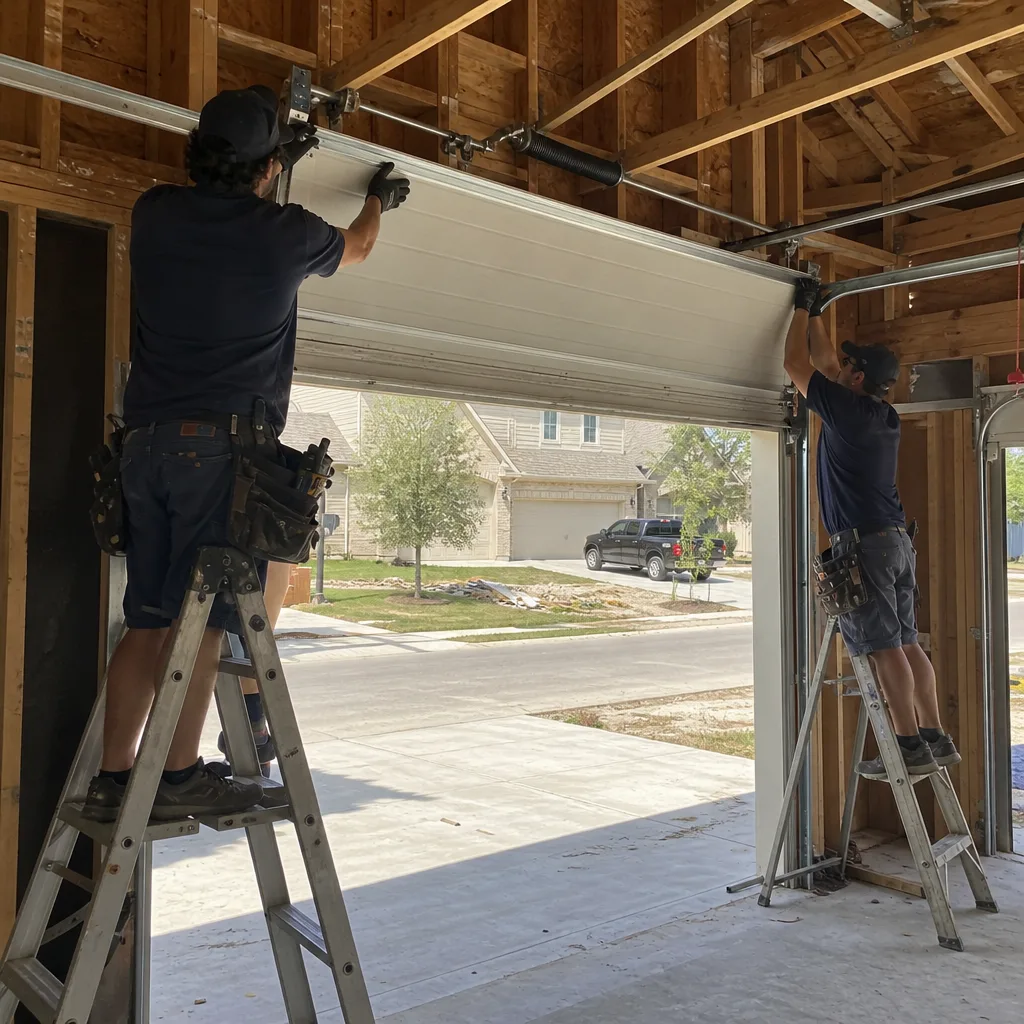
Call when you can’t confidently map the symptom to a component, when the severity level is “stop using,” or when the repair involves springs, cables, or electrical work. Call when you need a documented record of what was found and what was done, not just a verbal summary. Call when you want a flat, written price before anyone touches your door - because “trust us” is not a business model.
Servo Garage Doors Tomball offers free estimates in Tomball. We answer calls 24 hours a day, 7 days a week, including holidays. Emergency calls reach a real person, not a recording. The technician is named, background-checked, and uniformed. You’ll receive an on-the-way text with their photo and ETA, and every visit closes with a documented photo record of findings and completed work, delivered to you. That’s Clause 4, tracing back to how we started in 2015. Call (346) 703-6675.
Frequently Asked Questions
Standard torsion spring replacement for a residential door in Tomball typically runs $180-$340, including both springs, cable inspection, and door rebalancing. We replace springs in pairs even if only one is broken, because matched wear prevents immediate second failure. The price is flat and written before work starts - Clause 1 of The Haven Standard. Call (346) 703-6675 for an exact quote; estimates are free.
Roller and hinge lubrication, track cleaning, and photo-eye alignment are safe homeowner maintenance. Anything involving the spring system, cables, or opener electrical components requires a trained technician - the stored energy in springs and cables can cause serious injury or death, and opener electrical work involves line voltage and safety system liability. We document what we find with photographs so you see the evidence, not just hear our assessment.
This pattern almost always indicates opener logic board degradation or safety sensor interference from moisture. In Tomball’s climate, we see this frequently in uninsulated garages and in homes near Spring Creek or in low-lying subdivisions. The circuit board’s solder joints expand and contract with temperature; humidity accelerates corrosion at the micro-fractures. We diagnose with a humidity exposure assessment and quote board replacement or environmental mitigation. Bring us a competing written estimate and we’ll provide a free second opinion.
How do I know if my garage door opener needs replacement or just repair?
Three factors determine repair vs. replace: age, parts availability,