
Last updated September 21, 2026
Full 25-point door and opener safety check with every visit - springs, cables, rollers, tracks, and your LiftMaster or Chamberlain opener included
You get a price before we start. It does not change when the truck arrives.
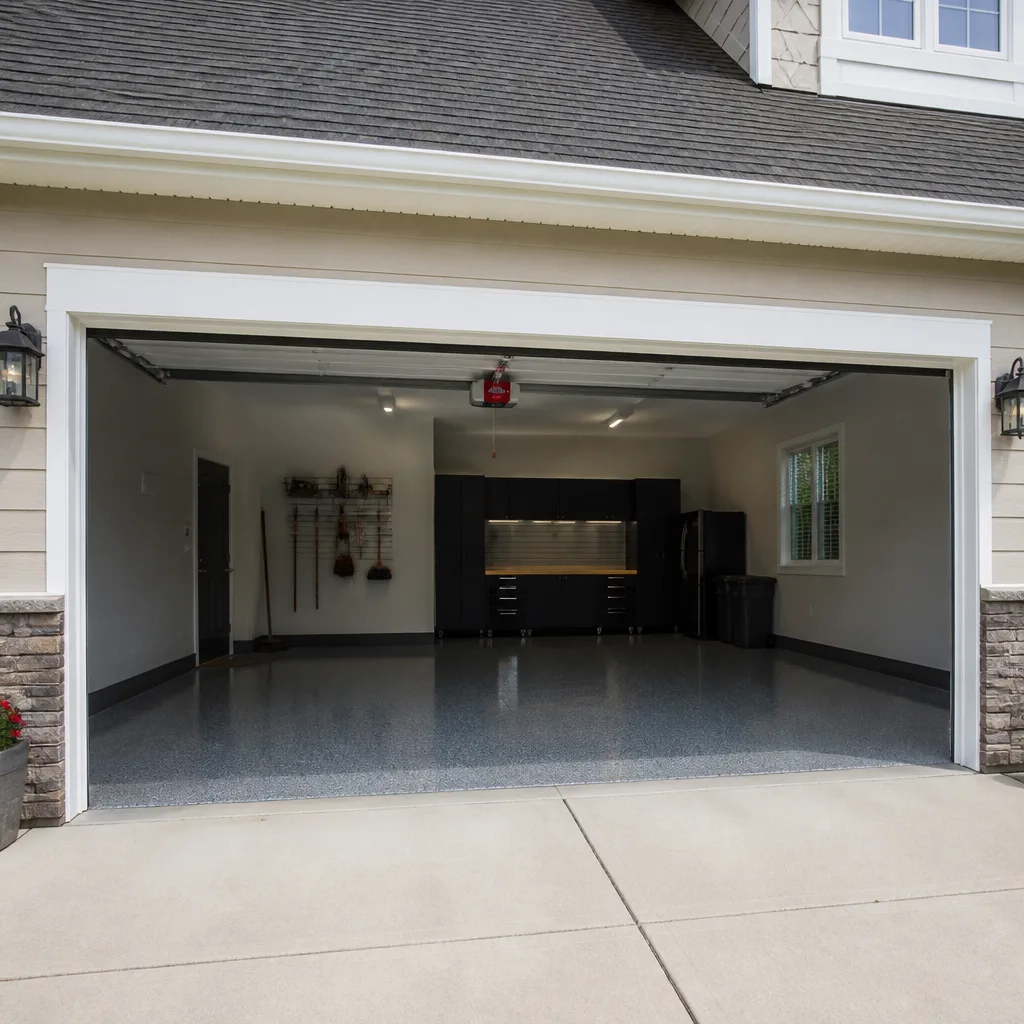
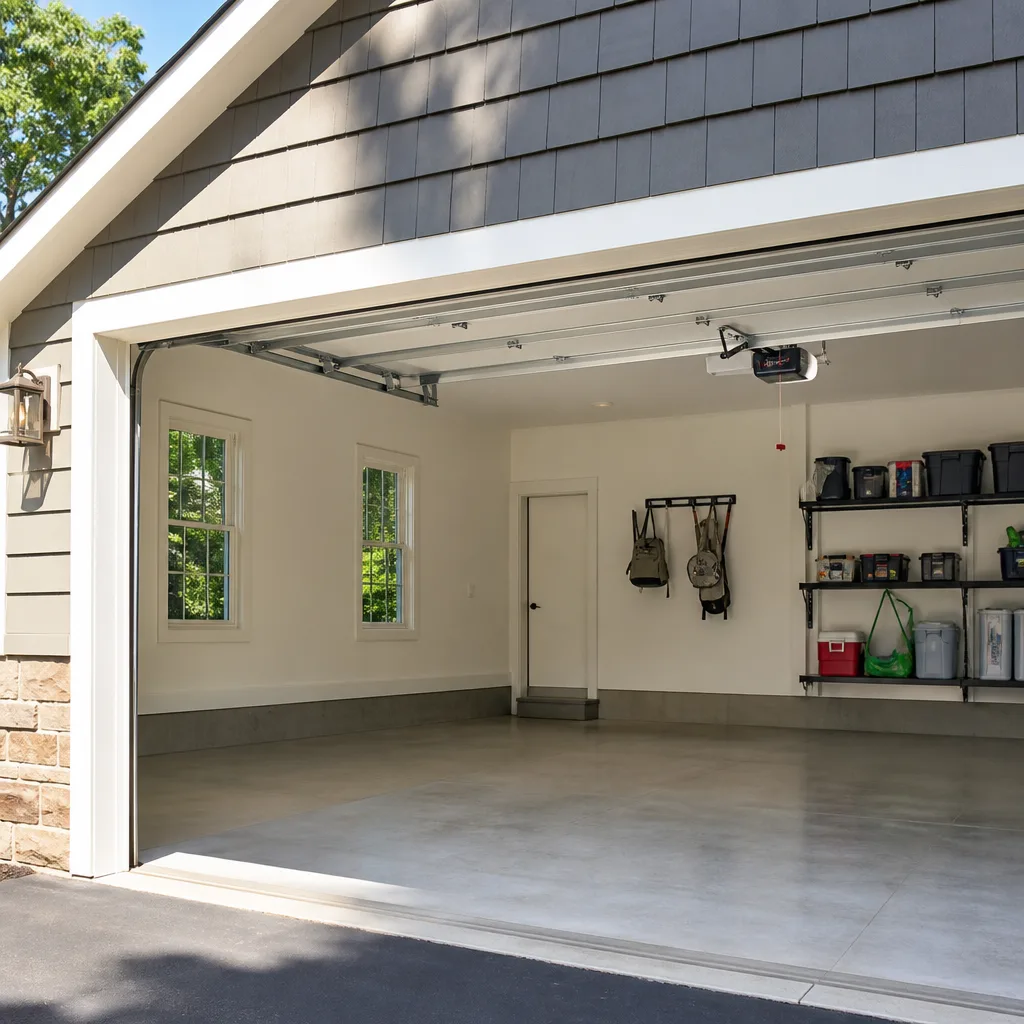
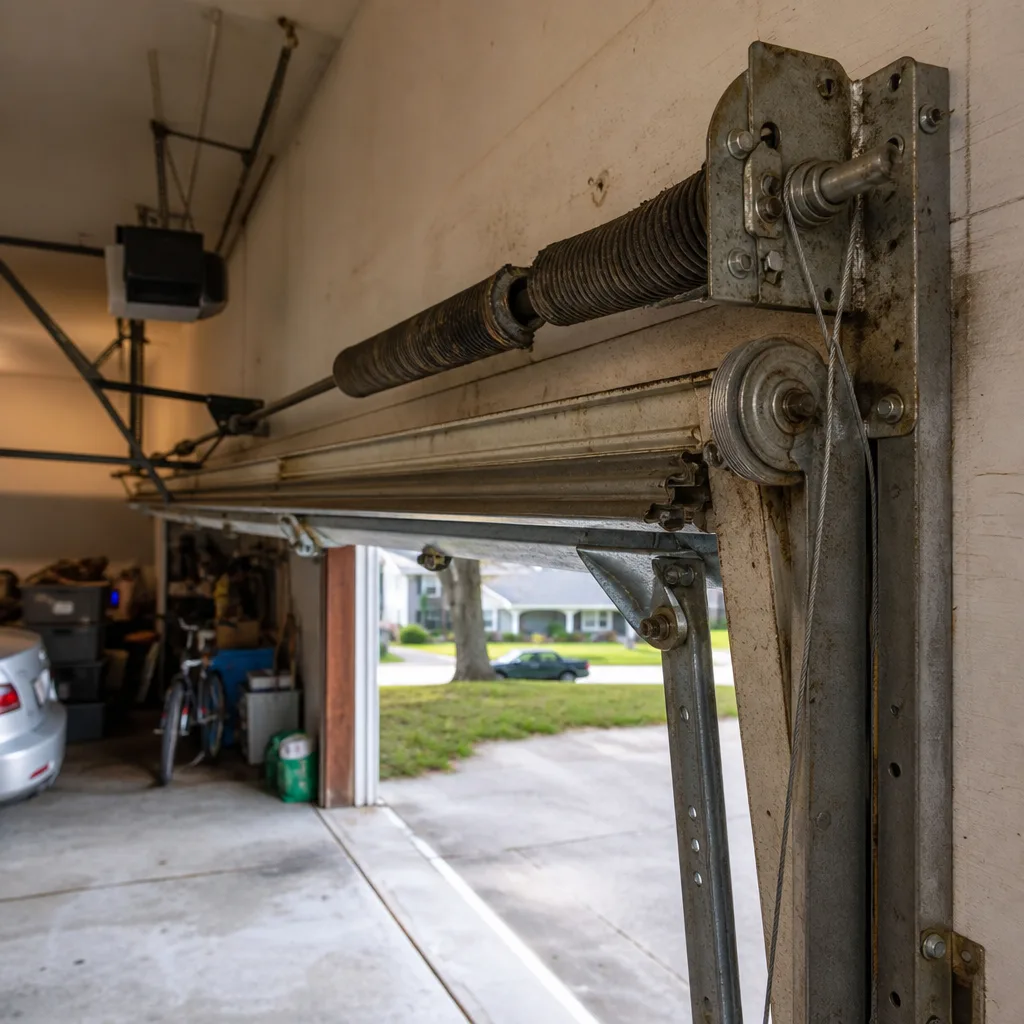 Before
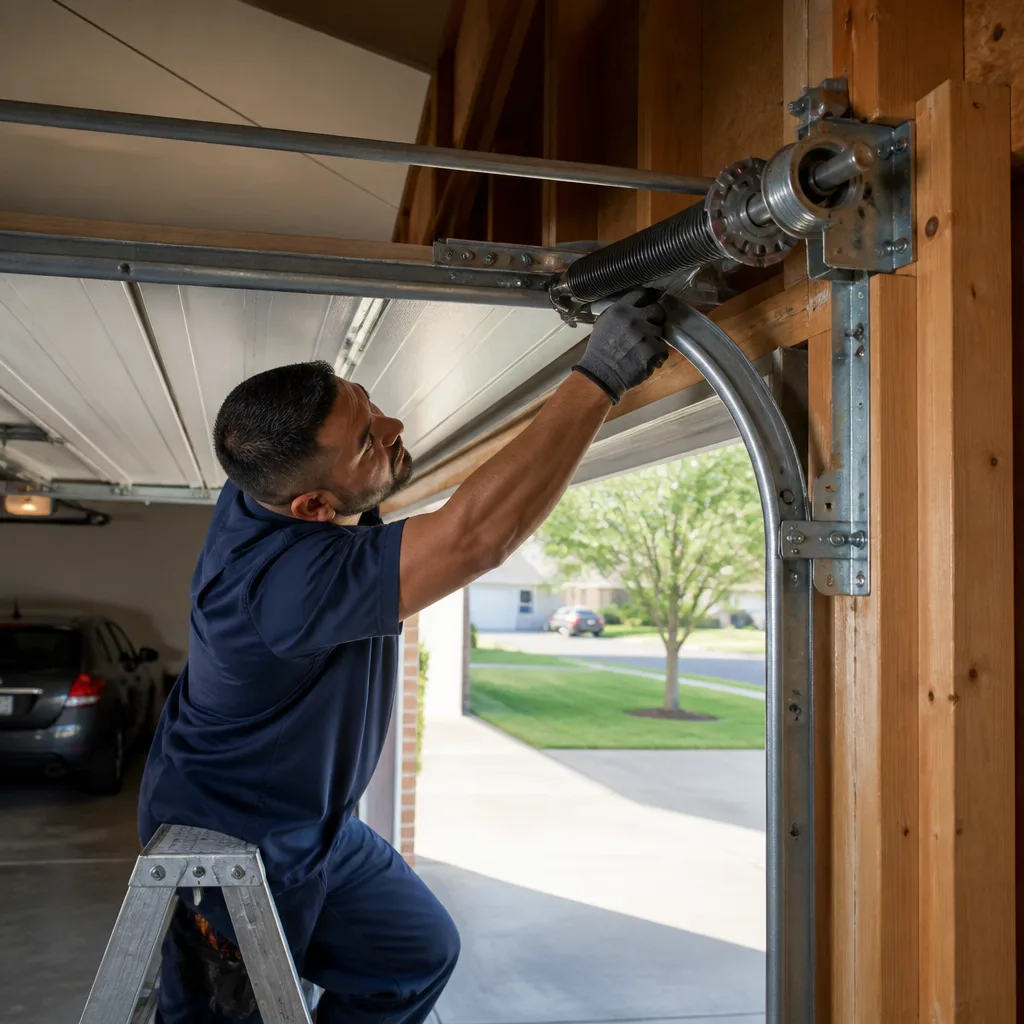 After
After Before
 After
After Before
 After
AfterThe Complete Guide to Garage Door in Tomball
Tomball sits inside ASHRAE Climate Zone 2A, which means your garage door faces more annual humidity stress than 80% of U.S. zip codes. That single fact eliminates several popular door materials before the first measurement is taken. In this guide and our more guides & resources, we’ll walk through every decision a Tomball homeowner actually faces - from Harris County permit thresholds to humidity-driven hardware failures - as a sequential decision tree, not a catalog. By the end, you’ll know how to read an R-value claim against a 130°F garage interior, which components break first in our climate, and why the right door is determined by the opening it fills and the climate it fights, not the style sheet.
Quick Answer
For Tomball homeowners, the right garage door starts with steel, aluminum, or fiberglass construction rated for ASHRAE Zone 2A humidity, matched to your opening size (single 9×7, double 16×7, or RV-height), with spring and track hardware selected for the actual door weight rather than the label claim. Expect to budget $1,200-$3,800 for a complete replacement in Tomball, detailed in our Garage Door Cost Breakdown: The Tomball Homeowner’s Reference for 2026, with Harris County permit requirements triggered at the $1,500 project threshold for new construction but not for direct replacement of existing doors on existing structures.
Table of Contents
- How Tomball’s Climate Zone Eliminates Certain Materials Before You Measure
- The Three Opening Sizes in Tomball Subdivisions and What Each Requires
- Steel, Aluminum, Fiberglass, and Wood Composite: What Works Here
- Reading R-Value Claims Against Tomball Summer Reality
- Harris County Permits: The $1,500 Threshold and What Triggers It
- The Documented Failure Sequence in Tomball’s Climate
- Matching Your Opener to Door Weight and Usage
- Sequencing Your Maintenance Budget by Component Lifespan
 Before
 After
AfterHow Tomball’s Climate Zone Eliminates Certain Materials Before You Measure
ASHRAE Climate Zone 2A covers the southeastern Texas corridor from Houston north through Tomball, Spring, and The Woodlands. The “2” means hot; the “A” means humid. Tomball averages 75-80% relative humidity through summer months with heat indices regularly exceeding 105°F. For garage doors, this creates three specific stressors that material selection must answer.
Moisture cycling is the first. Every afternoon thunderstorm drops humidity further; every evening it rises again. Materials that absorb and release moisture - solid wood, unsealed wood composites, certain vinyl formulations - swell and contract on a daily rhythm. In drier climates this happens seasonally. In Tomball it happens weekly. We’ve documented frame distortion on wood-composite doors in Villages of Creekside and Cherry Street Townhomes within 18 months of installation, even when manufacturer specs claimed “humidity-resistant” cores.
UV degradation of surface coatings is the second. South- and west-facing doors in Tomball subdivisions like Wimbledon Champions and Lakes at Creekside receive 6-8 hours of direct summer sun. Dark-colored doors, especially those with lower-grade polyester topcoats, chalk and fade within 3-4 years. Powder-coated steel and anodized aluminum hold up; painted wood and lower-end fiberglass gel coats do not.
Hardware corrosion is the third. Hinges, rollers, and track brackets in Tomball garages show surface oxidation faster than identical hardware in Dallas or Austin. The combination of humidity, occasional garage floor flooding from heavy rains, and temperature differentials between garage interior and exterior creates condensation on metal surfaces that accelerates rust.
What this means practically: before you select a door style, you’ve already narrowed materials to steel (with proper coating), aluminum, or fiberglass with UV-stable gel coat. Wood composite can work, but only with specific edge-sealing protocols that most Tomball installers skip. Solid wood is a maintenance commitment most homeowners underestimate.
The Three Opening Sizes in Tomball Subdivisions and What Each Requires
Walk through any Tomball neighborhood built after 2005 and you’ll find one of three opening configurations. Each changes what hardware you need, what spring system is appropriate, and what the installed price looks like.
Single Car: 9 Feet by 7 Feet
The standard single-car opening in Tomball - common in older sections of Northampton and throughout Tomball Terrace - measures 9 feet wide by 7 feet high. Door weight for a steel panel construction typically runs 85-120 pounds depending on insulation level and panel gauge.
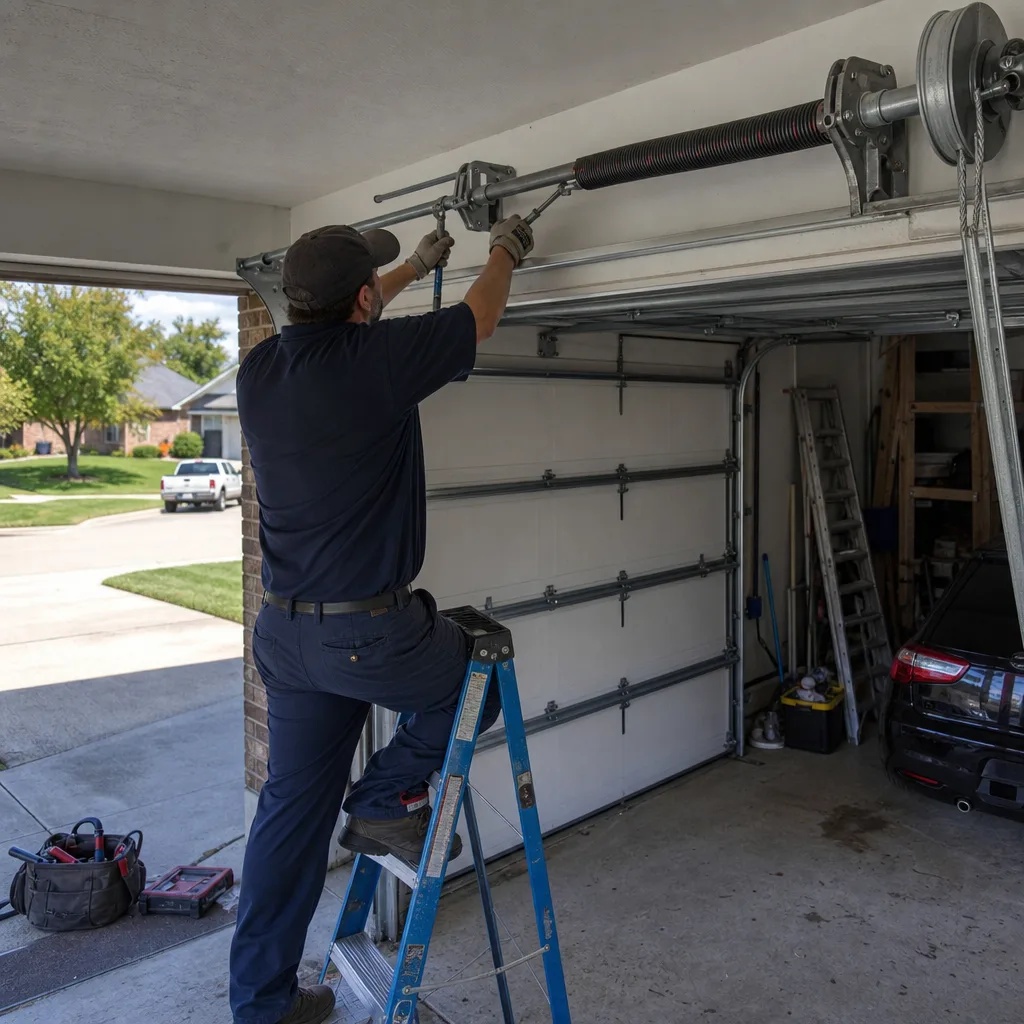
Spring selection matters here. A single 9×7 door uses either one torsion spring or two extension springs. We specify torsion springs on every Tomball single-door installation. Extension springs run parallel to the horizontal tracks, stretch and contract with every cycle, and in Tomball’s humidity they corrode at the cable attachment points faster. Torsion springs mount on a steel shaft above the door, distribute torque evenly, and last 15,000-20,000 cycles versus 10,000 for typical extension springs.
Opener sizing: a 1/2-horsepower chain-drive or belt-drive unit from LiftMaster or Chamberlain handles this door weight with margin. For homes in Tomball’s older core where ceiling height is limited to 8 feet, a jackshaft opener (wall-mounted beside the door) preserves overhead storage space.
Double Car: 16 Feet by 7 Feet
The 16×7 double-car opening dominates post-2010 Tomball construction: Canyon Gate at Legends Ranch, Amira, and most of the Rosehill corridor. Door weight jumps to 150-220 pounds for insulated steel construction.
This weight threshold changes spring math. A 16×7 door requires a torsion spring system, full stop. The spring wire diameter, inside diameter, and length are calculated from actual door weight, not manufacturer estimate. We’ve found label weights on 16×7 doors to run 10-15% light once hardware and window inserts are added. Using the label weight for spring selection leads to under-spec springs that fail early - a pattern we see regularly in Tomball warranty calls on doors installed by crews who didn’t scale the door before ordering springs.
Opener sizing moves to 3/4 horsepower minimum. A 1/2-horsepower unit will lift a 16×7 door when new, but runs at thermal limit on hot Tomball afternoons and burns out the motor or logic board within 4-6 years. The right opener for a double door in Tomball is sized for the actual weight plus 25% margin.
RV-Height: 16 Feet by 8 Feet or Taller
RV-height openings appear in Tomball’s acreage communities and custom builds: the 77377 zip code corridor, sections of Rosewood, and properties along Spring-Cypress Road. These 8-foot, 9-foot, or 10-foot heights solve motorhome and tall truck clearance but introduce structural challenges standard doors don’t face.
The taller door panel creates more wind load surface area. Tomball’s position on the northern Harris County line puts it inside the 120 mph wind zone per IRC 2021. A 10-foot-high door in a 16-foot width needs heavier gauge track, more track brackets, and often a wind load-rated door construction that standard residential products don’t offer. We’ve replaced track systems on RV-height doors in Tomball where the original installer used standard residential hardware and the door developed track spread within two years.
Spring systems for RV-height doors require custom calculation. The standard torsion spring charts stop at 8 feet. Above that, spring engineering accounts for the longer moment arm and the increased cable travel. Wrong springs on tall doors either fail to balance the door or create dangerous stored energy levels.
Steel, Aluminum, Fiberglass, and Wood Composite: What Works Here
With climate and opening size established, material selection becomes straightforward. Here’s how each performs in Tomball’s specific conditions.
Steel: The Default Choice
Steel garage doors account for roughly 70% of our Tomball installations. The material works because it doesn’t absorb moisture, it accepts durable coatings, and it provides structural rigidity at reasonable weight.
The specification that matters is gauge and coating. Residential steel doors come in 24-gauge (thickest common residential), 25-gauge, 26-gauge, and 27-gauge (thinnest). For Tomball, we specify 24- or 25-gauge on all doors wider than 14 feet and any door with window inserts, which create stress concentration points. The thinner gauges dent more easily from basketball impacts and wind-borne debris during spring storms.
Coating specification is where manufacturers differ and where Tomball’s UV exposure matters. Galvanized steel with a polyester topcoat lasts 8-12 years before chalking. Galvanized steel with a fluoropolymer (Kynar 500 or equivalent) topcoat lasts 15-20 years. The price difference is $200-$400 on a 16×7 door. Over a 15-year ownership period, the fluoropolymer coating is the lower-cost choice.
Insulation options for steel doors: uninsulated (no backing), vinyl-backed, or steel-backed with polyurethane or polystyrene fill. For attached garages in Tomball, we specify steel-backed polyurethane. The steel backing prevents the interior skin from being punctured by ladder handles or bike pedals, and polyurethane provides better R-value per inch than polystyrene.
Aluminum: For Specific Applications
Aluminum doors weigh roughly 40% less than equivalent steel doors. In Tomball, we specify aluminum for two scenarios: oversized openings where door weight would require heavier opener and spring hardware, and coastal-exposure situations where salt air accelerates steel corrosion.
Tomball isn’t coastal, but the chemical environment in some garages - fertilizer storage, pool chemical storage, workshop solvents - creates similar corrosion risk. Aluminum doesn’t rust; it forms a stable oxide layer. The tradeoff is softness: aluminum dents more easily than steel and doesn’t hold magnetic weatherstripping as securely.
We install aluminum doors from Raynor and Clopay product lines for Tomball customers with RV-height openings or specific corrosion concerns. Pricing runs 15-25% above equivalent steel construction.
Fiberglass: Niche but Valid
Fiberglass garage doors mimic wood grain without wood’s moisture absorption. The material works in Tomball when the gel coat is UV-stable and the core is polyurethane-filled, not hollow. Hollow-core fiberglass doors flex in wind and delaminate at hinge points within 5-7 years in our climate.
We’ve replaced fiberglass doors in Tomball’s Gleannloch Farms area where the original gel coat chalked within 4 years, and in Willow Creek where hollow-core construction led to panel cracking at window cutouts. Properly specified fiberglass is viable; improperly specified fiberglass is a mid-life replacement waiting to happen.
Wood Composite: The Cautionary Tale
Wood composite doors - fiberboard or particleboard cores with wood veneer or hardboard skins - present the biggest material risk in Tomball. Manufacturer specs rate them for “moderate humidity.” ASHRAE Zone 2A is not moderate humidity.
The failure mode is edge swelling. Moisture migrates through the bottom rail, the hinge mortises, and any unpainted edge. The core expands, the skin delaminates, and the door develops a wavy profile that binds in the tracks. We’ve documented this on composite doors in Tomball as early as 14 months after installation.
If a wood-look door is non-negotiable, we specify fiberglass with wood-grain gel coat or steel with wood-grain embossing and factory-applied stain. Both provide the aesthetic without the moisture vulnerability.
Reading R-Value Claims Against Tomball Summer Reality
Garage door R-values range from 0 (uninsulated) to 18+ (premium polyurethane-filled steel). Manufacturers market these numbers aggressively. Here’s how to interpret them for Tomball conditions.
What R-value actually measures: thermal resistance through the door panel itself, tested in a laboratory condition with still air on both sides. It does not account for air leakage around the door perimeter, thermal bridging at the panel edges, or radiant heat transfer through the door surface.
Tomball summer reality: an attached garage with attic space above routinely hits 120-130°F in July and August. The garage door is the largest exterior surface. An uninsulated steel door in direct sun reaches surface temperatures of 160°F+. That radiant heat transfers to the garage interior regardless of the R-value number printed on the brochure.
Here’s what we’ve measured in Tomball homes:
- Uninsulated steel door, west-facing, July afternoon: garage interior 128°F, adjacent kitchen wall 94°F
- R-10 polyurethane-filled steel door, same orientation, similar home: garage interior 112°F, adjacent kitchen wall 87°F
- R-10 door with added radiant barrier on interior face: garage interior 106°F
The R-value matters, but air sealing matters as much. A high-R door with gaps at the bottom seal and sides leaks conditioned air and admits humid outdoor air. We specify vinyl bulb bottom seals with dual contact points and PVC stop molding with integrated weatherstripping on every Tomball installation. The R-value of the panel is undermined if the perimeter leaks.
For attached garages with living space above or adjacent, we recommend R-12 minimum with full perimeter air sealing. For detached garages or unconditioned workshops, R-6 to R-8 is sufficient and the cost difference ($300-$500 on a 16×7 door) is rarely recovered in energy savings.
Harris County Permits: The $1,500 Threshold and What Triggers It
Permit requirements confuse Tomball homeowners because the city straddles Harris and Montgomery counties, with a small portion in Waller County. Most Tomball addresses fall under Harris County jurisdiction for unincorporated areas or City of Tomball building department for addresses inside city limits; see our full guide to Garage Door Permits, Codes & Inspections in TX: What You Need to Know.
The $1,500 threshold: Harris County requires a building permit for garage door work when the project value exceeds $1,500 and the work involves new construction, structural modification, or electrical work. Direct replacement of an existing garage door on an existing structure - same size, same location, no electrical changes - typically falls below permit trigger even when the door itself costs more than $1,500.
However, three scenarios in Tomball commonly trigger permit requirements:
- Converting a carport to enclosed garage with new door installation: this is new construction, permit required, structural plans may be required for the wall framing and header.
- Enlarging an existing opening - widening from single to double, or raising height for RV clearance: structural modification of the header and jambs, permit required.
- Adding electrical circuits for new opener installation where no outlet exists within 6 feet of the opener location: electrical permit required, must be performed by a licensed electrician or under electrical contractor supervision.
City of Tomball permits for addresses inside city limits follow similar thresholds but with different fee schedules. The City of Tomball Building Department issues permits for work within city limits; Harris County Public Infrastructure handles unincorporated areas.
We handle permit research as part of our pre-installation site visit for any Tomball project where the scope suggests permit trigger. The customer receives documentation of permit status, permit number if required, and inspection scheduling if applicable. This is part of the written scope delivered before work starts under Clause 1 of The Haven Standard.
The Documented Failure Sequence in Tomball’s Climate
After 18,000+ garage door service calls since 2015, we’ve tracked component failure patterns specific to southeast Texas climate conditions. Understanding this sequence helps Tomball homeowners budget maintenance and recognize early warning signs.
Year 1-3: Bottom Seal and Weatherstripping
The first component to fail is almost always the bottom seal. In Tomball, the combination of UV exposure, ozone from vehicle exhaust, and contact with concrete that reaches 140°F in summer causes vinyl and rubber seals to harden and crack. We’ve replaced bottom seals on doors installed 18 months prior in Tomball’s sunniest orientations.
Symptom: visible daylight under the door when closed, or water intrusion during heavy rains. The fix is straightforward: $85-$140 for seal replacement, including the retainer if the original used a generic snap-in profile that no longer holds tension.
Year 3-5: Rollers and Hinges
Standard steel rollers with unsealed bearings accumulate dust and moisture, then seize. In Tomball’s humidity, we’ve documented roller seizure as early as 2.5 years on doors with heavy cycling (families with multiple drivers, home-based businesses with frequent deliveries).
Nylon rollers with sealed ball bearings last 7-10 years under identical conditions. The upgrade cost is $8-$12 per roller versus $3-$5 for standard steel. On a 16×7 door with 10 rollers, the difference is $50-$70 at installation and typically prevents a mid-cycle service call.
Hinge corrosion follows roller issues. Steel hinges with standard zinc plating show red rust at the pin and barrel within 4 years in Tomball garages with any moisture exposure. We specify galvanized or stainless hinges on replacement work; the cost difference is negligible and the lifespan doubles.
Year 5-8: Spring Fatigue
Torsion springs are rated in cycles: one open and one close. Standard residential springs are 10,000-cycle rated. With 4 cycles per day (two-car family, both commuters), that’s roughly 7 years. In practice, Tomball’s heat and humidity reduce cycle life by 10-15% through accelerated metal fatigue and corrosion at the wire surface.
Spring failure is dangerous - the stored energy in a wound torsion spring can cause serious injury if released improperly. We do not recommend homeowner inspection or replacement of torsion springs. The symptoms are door heaviness on manual lift, visible gap in the spring coils, or loud bang from the garage. If you observe any of these, stop using the door and call for service.
Year 8-12: Opener Wear and Logic Board Failure
Garage door openers in Tomball fail in a predictable pattern. The motor itself rarely fails first; the logic board (the circuit board that controls safety sensors, travel limits, and radio receivers) fails from thermal cycling and power fluctuation. Summer garage temperatures of 130°F stress capacitors and voltage regulators. We’ve replaced logic boards on 6-year-old openers in west-facing Tomball garages where the unit received no shade.
Drive components follow: chain stretch on chain-drive units, belt deterioration on belt-drive units, trolley carriage wear on all types. LiftMaster and Chamberlain belt-drive units with DC motors and soft-start/stop programming show the longest service life in our Tomball data - typically 12-15 years versus 8-10 for basic chain-drive AC motor units.
Year 12-18: Panel and Section Degradation
The door itself becomes the maintenance item in this window. Steel doors may show coating failure and surface rust, especially at panel edges and window frames. Insulation core may settle or delaminate, creating visible panel distortion. Hardware attachment points fatigue from millions of vibration cycles.
At this age, we evaluate repair-versus-replace economics with Tomball homeowners. A new door installation with current hardware and opener technology typically outlasts piecemeal repair of a 15-year-old door, and the energy performance improvement is measurable.
Matching Your Opener to Door Weight and Usage
Opener selection follows door specification, not the reverse. The common mistake we correct in Tomball is homeowners replacing a failed opener with the same horsepower rating without verifying it’s adequate for the actual door.
Step 1: Determine actual door weight. We scale every door during our site visit. Label weights are estimates; actual weight includes hardware, windows, and any aftermarket additions like decorative hardware or struts.
Step 2: Calculate duty cycle. A door cycled 2 times daily is light duty. A door cycled 6+ times daily - common in households with teenagers, home businesses, or multi-generational living - is heavy duty. Heavy duty demands a 3/4-horsepower or 1-horsepower opener with DC motor and thermal overload protection, even on a single 9×7 door.
Step 3: Select drive type.
- Chain drive: lowest cost, highest noise, requires periodic lubrication. Acceptable for detached garages in Tomball. We install LiftMaster chain-drive units for budget-conscious customers with non-adjacent garage configurations.
- Belt drive: quiet operation, no lubrication, higher cost. Required for attached garages with bedrooms above or adjacent. Chamberlain and LiftMaster belt-drive units with steel-reinforced belts are our standard specification for Tomball attached garages.
- Jackshaft (wall-mount): preserves overhead space, requires torsion spring and specific header clearance. Ideal for Tomball homes with 8-foot ceilings or overhead storage systems. Genie and LiftMaster jackshaft models are reliable; installation requires 12 inches of side room and a properly balanced door.
- Screw drive: we do not specify screw-drive openers for Tomball. The threaded steel rod requires lubrication that attracts dust, and the plastic carriage components fatigue in heat. Our service data shows higher failure rates for screw-drive units in Zone 2A conditions.
Step 4: Verify safety features. Federal law requires photoelectric sensors (eye beams) on all openers manufactured after 1993. We verify sensor alignment and obstruction response on every Tomball service call. Additional features we specify: force-sensing auto-reverse, timer-to-close, and battery backup (required in California, prudent in Texas for power outage operation).
For opener repair or replacement in Tomball, we provide written specification of recommended unit, installed price, and removal/disposal of existing opener before any work begins.
Sequencing Your Maintenance Budget by Component Lifespan
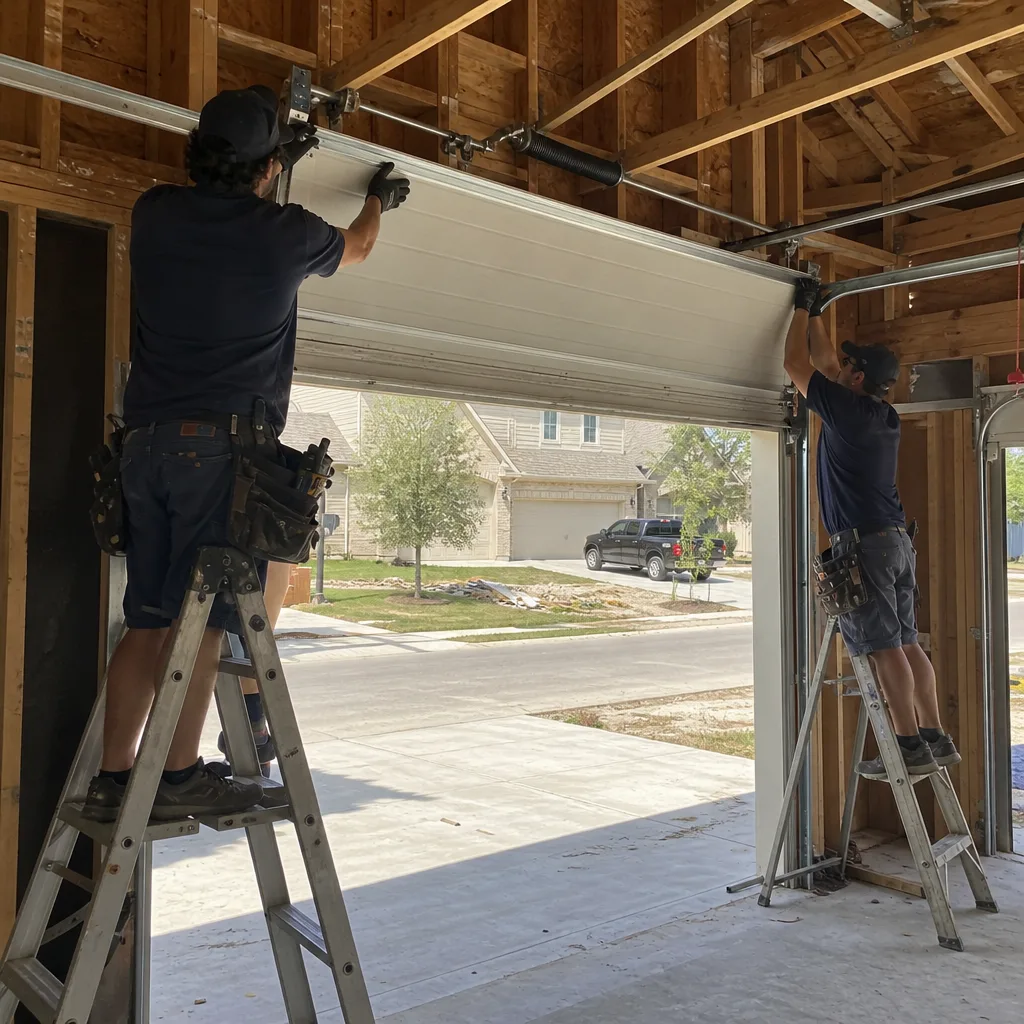
Proactive maintenance extends component life and prevents emergency calls. Here’s a Tomball-specific maintenance schedule based on our failure data.
Annual: Visual Inspection and Lubrication
Every spring, inspect the door from the inside with the opener disconnected. Check for:
- Bottom seal integrity: cracks, compression set, daylight visible underneath
- Roller condition: wobble on the shaft, binding in the track, noise during operation
- Spring appearance: rust, coil gap, oil staining (indicates internal wear)
- Cable fraying: especially at the bottom fixture attachment where moisture collects
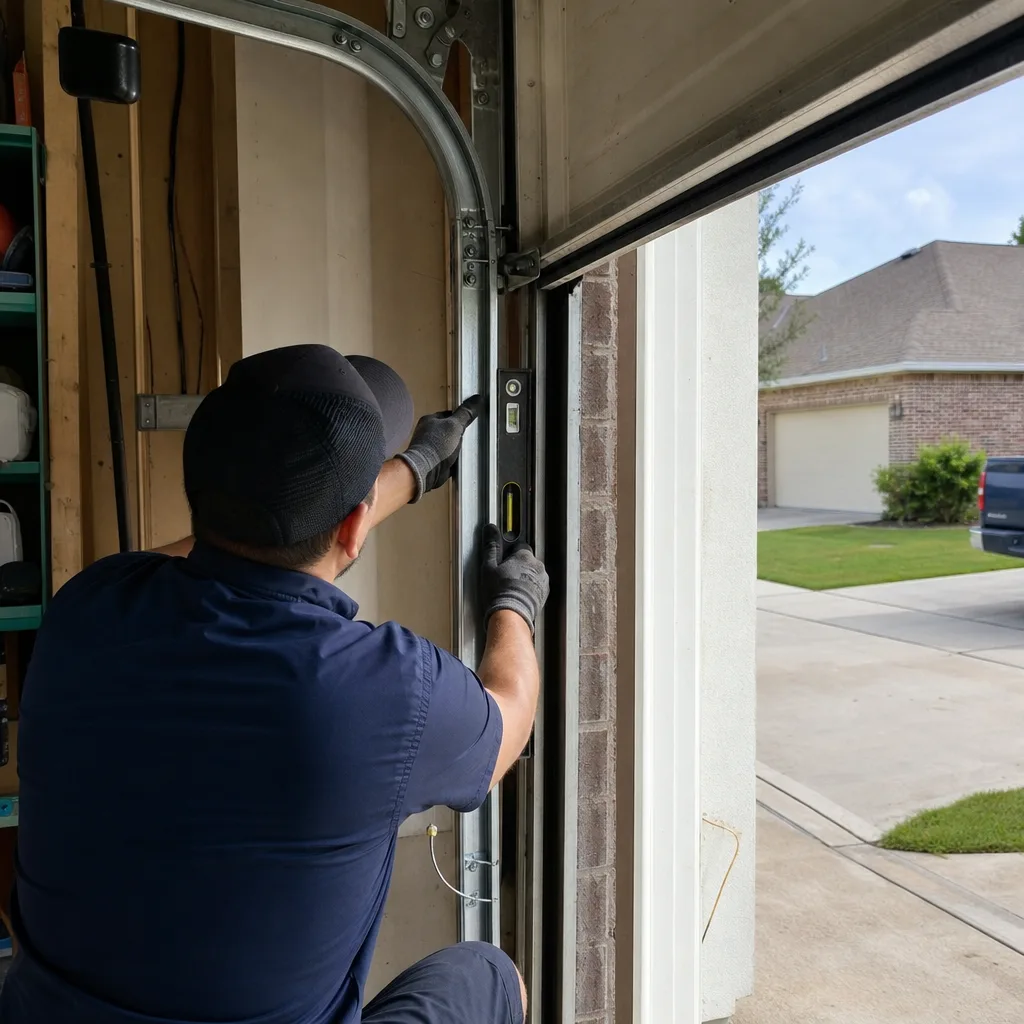
- Track alignment: vertical tracks plumb, horizontal tracks level, bracket fasteners tight
Lubricate steel hinges, rollers with unsealed bearings, and torsion spring with lithium-based garage door lubricant. Do not lubricate the track surface; lubricant on tracks attracts dust and creates a grinding paste. Do not touch the torsion spring itself beyond light lubrication of the coils; spring adjustment requires specialized tools and training.
Bi-Annual: Hardware Torque Check
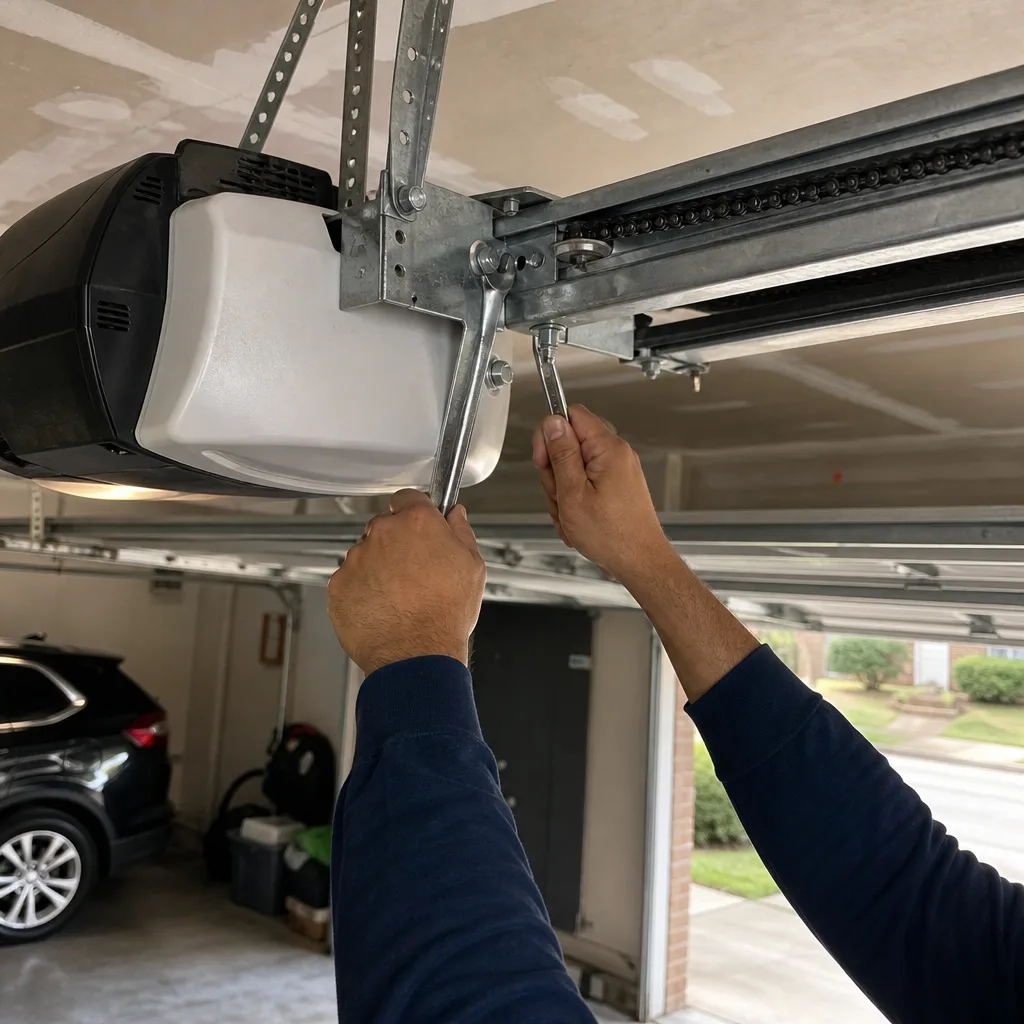
Vibration loosens fasteners. Every six months, check and tighten track bracket bolts, jamb bracket fasteners, and opener mounting hardware. Use a socket wrench, not a screwdriver; the torque required exceeds what hand tools provide.
Every 3-5 Years: Component Replacement
Budget $200-$400 for preventive replacement of rollers, hinges, and bottom seal before failure. This is typically half the cost of an emergency call after component failure, and it prevents secondary damage - a failed roller can derail a door, bending track and stressing the opener.
Every 10-15 Years: Spring and Opener
Torsion springs and openers have finite lives. Planning replacement before failure avoids the inconvenience of a door that won’t open on a Monday morning or a Saturday evening. We provide condition assessments with photo documentation on every service visit, so Tomball homeowners can anticipate these larger expenses.
Common Mistakes to Avoid
- Specifying wood composite without edge-sealing protocol: In Tomball’s humidity, unsealed composite edges swell within 18 months. Verify the installer seals all six sides of the door, including cutouts for windows and hardware.
- Using label weight for spring selection on 16×7 doors: Actual door weight with hardware and windows typically exceeds label weight by 10-15%. Under-spec springs fail early and strain the opener.
- Installing a 1/2-horsepower opener on a heavy double door: The opener will lift the door when new but runs at thermal limit, shortening motor and logic board life. The false economy costs more in early replacement.
- Ignoring permit requirements for opening modifications: Widening or raising a garage door opening in Harris County without proper permit and inspection can complicate home sale and insurance claims.
- Choosing dark door colors for south- and west-facing orientations: Dark colors increase surface temperature 30-40°F versus white or light tan, accelerating coating failure and increasing garage heat load. In Tomball’s sun exposure, light colors are functional, not merely aesthetic.
- Skipping the written scope review: Any contractor who won’t document what’s included, what’s excluded, and the flat price before starting work is leaving room for invoice surprises. Clause 1 of The Haven Standard exists because this happens too often.
When to Call a Professional
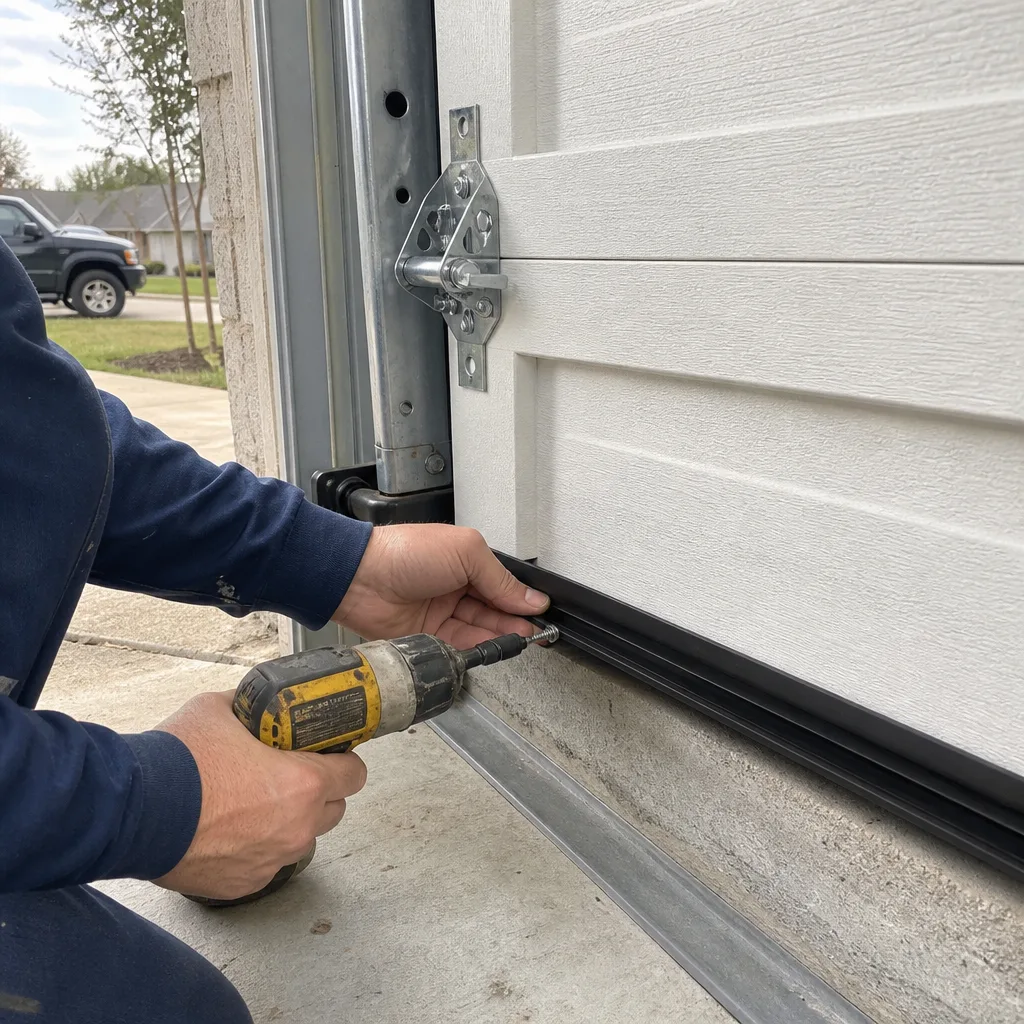
Some garage door work belongs to trained technicians with proper tools and safety protocols. Call a professional for: torsion spring repair or replacement (high stored energy, risk of serious injury); door derailment or cable failure (uncontrolled door weight); opener electrical work beyond plug-in replacement; any opening modification requiring structural header changes; and recurring issues that resist DIY diagnosis - the third adjustment of the same component suggests a root cause that systematic inspection will find.
For everything else - routine maintenance, weatherstripping replacement, remote programming - a competent homeowner with basic tools can handle the work. The line is safety: if a mistake could drop a 200-pound door or release spring energy, the task belongs to a technician.
Servo Garage Doors Tomball offers free estimates in Tomball - call (346) 703-6675. Every estimate includes a documented photo record of current conditions, a written scope of recommended work, and a flat price valid for 30 days. No coupon required; no “call for pricing” - Clause 1 of The Haven Standard applies to every visit.
Frequently Asked Questions
A complete garage door replacement in Tomball typically ranges from $1,200 for a basic single steel door to $3,800 for a premium insulated double door with hardware and opener. The price depends on door size, material, insulation level, window configuration, and whether the opener and track hardware are also replaced. We provide a flat, written price before any work starts - call (346) 703-6675 for a free estimate with no obligation.
A properly specified and maintained steel garage door lasts 20-25 years in Tomball’s climate. The critical factors are coating quality (fluoropolymer topcoats outlast polyester by 5-8 years), hardware specification (sealed-bearing rollers and galvanized hinges resist humidity corrosion), and preventive maintenance (annual inspection and lubrication). Wood composite doors, by contrast, often require replacement within 10-12 years in our humidity conditions.
Direct replacement of an existing garage door on an existing structure - same size, same location, no electrical changes - typically does not require a permit in Harris County or City of Tomball. A permit is required for new construction (carport conversion), opening enlargement, or electrical circuit additions. We verify permit requirements during our site visit and include permit status in the written scope. The $1,500 Harris County threshold applies to project valuation for new construction, not to replacement of existing doors.
For attached garages with living space above or adjacent, specify R-12 minimum with full perimeter air sealing. The R-value alone doesn’t tell the full story - air leakage around the door perimeter can negate panel insulation performance. For detached garages or unconditioned workshops, R-6 to R-8 is sufficient. In Tomball’s summer conditions, a radiant barrier on the interior door face provides measurable additional heat reduction beyond R-value alone.
Spring life is measured in cycles and reduced by environmental stress. A standard 10,000-cycle spring with 4 daily cycles should last 6-7 years; Tomball’s heat and humidity accelerate metal fatigue, reducing effective life 10-15%. Additionally, if the spring was specified to label weight rather than actual door weight, it operates under higher stress than designed. We measure actual door weight and specify cycle-rated springs appropriate to usage patterns - high-cycle springs rated 25,000+ cycles are available for heavily used doors.
A plug-in opener replacement on an existing properly balanced door is within capable homeowner range. New opener installation requiring electrical circuit work, header mounting, or door balancing adjustment belongs to a technician. The safety risk is door weight: an improperly balanced door can fall during opener installation, and the force adjustment must be calibrated correctly for the auto-reverse to function. We provide written specification and flat pricing for opener installation; the documentation includes safety sensor alignment verification and force testing.
The Bottom Line
The right garage door for your Tomball home emerges from three sequential decisions: climate-appropriate material selection (steel, aluminum, or fiberglass with UV-stable coating), opening-size-appropriate hardware specification (torsion springs sized to actual weight, opener matched to duty cycle), and honest assessment of thermal performance needs (R-value plus air sealing, not R-value alone). Harris County permits matter for new construction and modifications, not for direct replacement. Component failures follow a predictable timeline in our climate - budget for bottom seals at 2 years, rollers and hinges at 4 years, springs at 7 years, and openers at 10 years. The homeowners who spend least over a 20-year ownership period are those who specify correctly at installation and maintain preventively thereafter.
Written by Marcus Deller, Owner at Servo Garage Doors Tomball, serving Tomball since 2015.